Starting solids can be an exciting change, but it can also make a familiar nappy routine feel different. If you are reviewing your starting solids nappy disposal routine, you may notice that poo nappies are stronger-smelling or harder to leave indoors than they were during the milk-fed stage.
That does not automatically mean your nappy bin has stopped working or that you need to buy a new one. You may simply need to adjust how long poo nappies stay indoors, how often you empty the bin, or how quickly they move towards your household’s final waste route.
If temporary indoor containment still works better for your home, the Momcozy Triple-Seal Nappy Bin can provide a contained place for used nappies between changes and disposal trips. The key is to choose a routine that fits your household rather than changing your setup simply because your baby has started solids.
Key Takeaways
- Starting solids can make poo nappies more noticeable indoors, so the disposal routine that worked during the milk-fed stage may need to be reassessed.
- A stronger smell does not automatically mean your nappy bin has failed. Shorter indoor holding time or more frequent emptying may be enough to make the routine comfortable again.
- Some families take poo nappies straight to the outside bin after weaning, while others continue using a sealed nappy bin successfully.
- Fewer nappy changes later in infancy do not necessarily mean individual poo nappies can stay indoors longer.
- A dedicated nappy bin is most useful when your household still needs temporary indoor containment between the changing area and the final waste bin.
- If your existing routine still works after solids begin, there is no need to replace it simply because your baby has reached a new feeding stage.

What Can Change When Solids Begin?
As solids become part of your baby's diet, poo can become more formed and more strongly scented. The change is not identical for every baby, and the household may notice it in different ways.
The important point for nappy disposal is not whether a particular nappy is "normal". It is whether the change has affected how comfortable you are keeping dirty nappies indoors.
The milk-fed stage
During the milk-fed stage, your existing disposal routine may have been easy enough to manage. You might have kept used nappies in a nearby bin and emptied it according to your usual household schedule.
If the outside bin was several steps away, downstairs or outside the property, keeping a bin near the changing area may have saved a lot of unnecessary trips.
The transition after solids
Once solids are introduced, you may notice that poo nappies are harder to leave sitting indoors between bin collections or household emptying trips.
This can make an old routine suddenly feel less convenient even though nothing is technically wrong with the bin itself.
You may find that the main change you need is simply to remove poo nappies sooner.
Why disposal tolerance can change before the whole routine does
Starting solids does not mean you need to rebuild your entire changing setup.
If wet nappies still fit your existing routine, there may be no reason to change how you handle them. You can instead focus on the part of the routine that has become difficult: how long poo nappies remain indoors.
That small adjustment can be easier than replacing a bin or changing the location of your whole changing station.
Do Nappy Bins Stop Being Useful After Weaning?
No. There is no universal rule that says a nappy bin stops being useful once a baby starts eating solids.
Parents take different approaches. Some prefer to move poo nappies outside soon after a change, particularly when their outside bin is easy to reach. Others continue using a dedicated, sealed nappy bin because carrying every dirty nappy outside is inconvenient.
The better question is not whether nappy bins "work" after solids. It is whether your current disposal route still works for your home.
|
Keep the current routine |
Consider changing the routine |
|
Your bin still contains odour comfortably enough |
Poo nappies are becoming harder to tolerate indoors |
|
The changing area is far from the outside bin |
You can easily take poo nappies outside after each change |
|
Emptying the bin regularly is manageable |
The current emptying interval feels too long |
|
Indoor containment is useful at night |
You no longer need nearby temporary storage |
Some parents stop using nappy bins once their babies reliably eat solids, while others continue to find them useful. That difference is a household preference rather than proof that dedicated bins become unsuitable after weaning.
So, before replacing anything, look at the actual problem. Is the issue the bin, or is it simply that the old holding time no longer suits you?
Separate Poo Nappies From the Rest of the Routine
If the main problem after starting solids is poo odour, you do not necessarily need to change everything about your nappy-changing setup.
Think about poo nappies separately from wet nappies.
Keep the wet-nappy workflow if it works
If wet nappies are still easy to manage using your current bin or disposal routine, leave that part alone.
There is little benefit in making the entire routine more complicated because one part of it has changed.
Shorten poo-nappy holding
The simplest adjustment may be to reduce the amount of time poo nappies spend indoors.
For example, you might continue putting used wet nappies into your usual indoor bin while taking poo nappies outside sooner.
That creates a more targeted solution. Instead of replacing a system that still works for most changes, you change the part that is causing the most friction.
Reassess again as the routine changes
Your disposal needs may change again. Nappy frequency, household schedules and your baby's eating routine can all develop over time.
A solution that works now does not have to become a permanent rule.
Choose the Shortest Practical Route From Change to Final Disposal
Once a poo nappy has been changed, think about the route it takes before it reaches your household's final waste stream.
The shortest practical route is not always the same in every home.
Direct outside disposal
If your outside bin is close and easy to access, taking poo nappies out soon after a change can be the simplest option.
It removes the need to store them indoors and avoids adding another step to the disposal process.
For a ground-floor home with an easily accessible outside bin, this may make more sense than keeping a dedicated nappy bin nearby.
Temporary indoor containment
Immediate outside disposal is not equally practical for everyone.
An upstairs nursery, flat, multi-storey home or night-time change can make repeated trips outside inconvenient. In these situations, temporary indoor containment can still have a useful role.
The goal is not to keep nappies indoors indefinitely. It is to give you a contained place for used nappies until you make your normal household waste trip.
If you live in a flat and the outside bin is a long walk from your changing area, the nappy disposal in a flat route may also be worth considering.
When the route depends on the home
There is no single best disposal route for every family.
A parent living in a ground-floor house may find outside disposal simple. Someone changing a baby upstairs at 2am may reasonably prefer temporary indoor containment.
For the final waste route, see what bin do nappies go in.

Emptying More Often May Matter More Than Buying Something New
When nappies start smelling stronger after solids, buying a new bin can feel like the obvious answer. It may not be necessary.
The first thing to test is often how long nappies are staying in the indoor bin.
Why holding time matters
A bin may contain nappies adequately when it is emptied regularly, but the same setup can become less comfortable if dirty nappies remain inside for longer.
This is particularly relevant when your baby is changing less frequently but individual poo nappies are more noticeable.
Fewer nappies do not automatically mean each one can stay indoors for longer.
What should trigger an earlier empty?
There is no universal number of days that every family should follow.
Instead, use practical signs such as:
- The bin is filling more quickly than expected.
- Stored nappies are becoming noticeably more difficult to tolerate.
- Opening the bin releases an accumulated smell.
- Your household simply prefers to remove poo nappies sooner.
The aim is to find an emptying rhythm that suits your home rather than following a fixed schedule.
When frequent emptying defeats the point
If you find yourself emptying a dedicated bin so often that it no longer adds convenience, that is useful information too.
You may prefer to take poo nappies directly outside instead.
For more detailed odour-specific advice, see how to stop a nappy bin smelling.
If the Bin Smells When Opened, Reassess the Workflow Before the Product
A nappy bin can contain odour while closed but release more noticeable smells when the lid is opened.
That does not automatically mean the product has failed.
After solids begin, a stronger-smelling nappy combined with a longer indoor holding period can make opening the bin feel much less pleasant than it did before.
Closed vs opened-bin experience
There is a difference between containing waste and making the contents completely odour-free.
A sealed bin is designed to contain used nappies between changes, but the contents still need to be removed eventually.
If the biggest problem happens when the bin is opened, look first at how long the poo nappies have been stored and whether emptying sooner makes a difference.
Try a shorter hold
If the rest of the setup is convenient, try reducing the amount of time poo nappies remain inside.
You may find that this simple change brings the routine back into balance without replacing the bin.
When to troubleshoot
If the bin continues to smell despite a disposal routine that otherwise works, use a dedicated odour-troubleshooting guide rather than assuming that starting solids is the only cause.
The aim here is to reassess the workflow, not to repeat a full nappy-bin cleaning and odour guide.
When a Regular Lidded Bin May Still Be Enough
Starting solids does not automatically create a need for a dedicated nappy bin.
A regular lidded bin can still be a reasonable choice if it is close to the changing area, emptied frequently and comfortable for your household to use.
For some families, the simplest routine is also the best one.
Good fit for a regular bin
A regular lidded bin may work well when:
- The outside bin is easy to reach.
- You are happy to empty the indoor bin frequently.
- You do not need to store poo nappies indoors for long.
- The existing bin already contains smells well enough for your household.
- You would rather avoid adding another dedicated product.
The main benefit is simplicity. You can use a bin you already own rather than changing the setup because your baby has started solids.
When the routine starts to feel inconvenient
A regular bin may become less suitable if you find yourself making repeated trips outside or emptying it so frequently that it becomes a chore.
That is when dedicated indoor containment may start to make more sense.
The choice comes down to convenience, holding time and the layout of your home, rather than the baby's feeding stage alone.
When Dedicated Indoor Containment Becomes More Useful
A dedicated nappy bin becomes more relevant when poo nappies cannot realistically leave the home immediately and you still want the changing area to have a contained disposal point.
This can be particularly useful in:
- Upstairs nurseries
- Flats
- Multi-storey homes
- Night-time changing areas
- Homes where the outside bin is not close to the changing space
The key is that the bin should solve a real gap in your routine.
For example, the Momcozy Triple-Seal Nappy Bin is designed with Triple-Seal Odor Control, a wide opening, clear lid, patented clamp bag seal and child safety lock. The bin has a 22L capacity and is designed to work with standard 13-gallon bin bags.
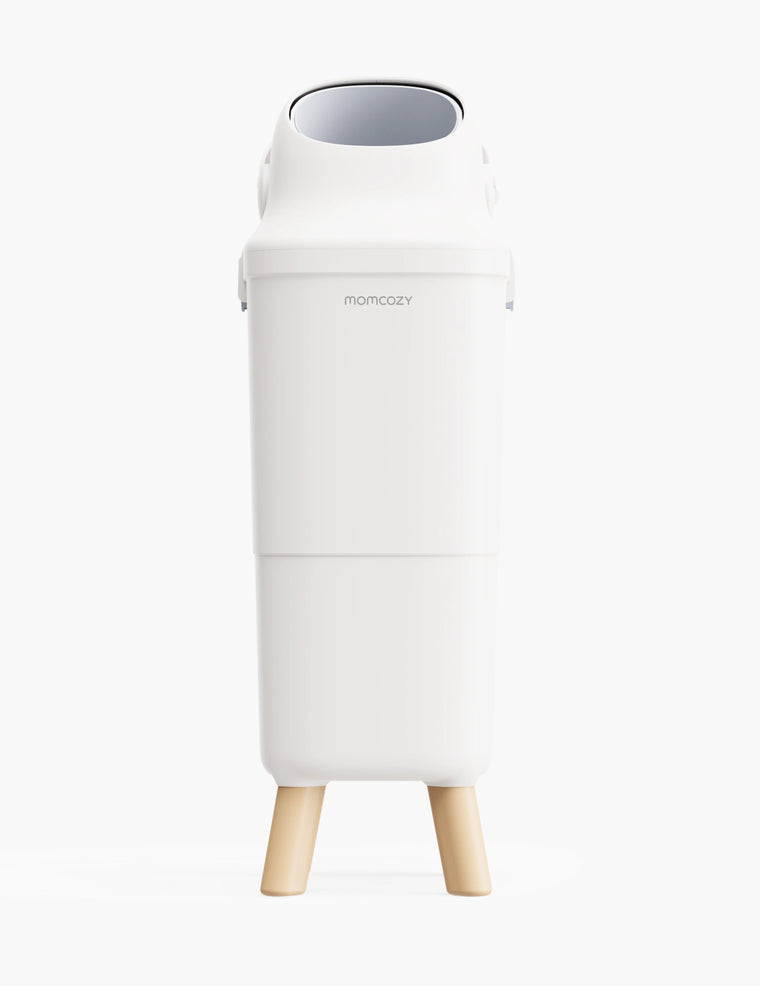
Those features may be useful if you still want temporary indoor containment after solids begin. The wide opening can make everyday disposal easier, while the sealing design is intended to help contain odours during storage.
But it is not automatically the right choice.
If your outside bin is easy to reach, your regular lidded bin already works or you simply prefer to take poo nappies outside immediately, dedicated indoor containment may add little value.
Before choosing a different setup, you can also need a nappy bin and consider how to choose the best nappy bin.
Three Post-Weaning Disposal Routines That Can All Be Reasonable
There are several ways to adjust your routine after starting solids. None needs to be treated as the universal answer.
|
Household pattern |
Routine |
Why it can work |
|
Outside bin is easy to reach |
Take poo nappies outside soon after the change; continue your usual wet-nappy routine |
Minimises indoor holding without adding another product |
|
Indoor bin still works |
Keep using the current nappy bin but empty it sooner when needed |
Keeps the convenience of nearby disposal while adapting to stronger odour |
|
Immediate outside disposal is inconvenient |
Use sealed indoor containment and remove the waste during a predictable household bin trip |
Balances home layout with the need for temporary containment |
The important part is flexibility. If one routine works for your family now, you do not need to change it simply because another parent handles poo nappies differently.
Likewise, if your current routine suddenly feels unpleasant, you can change one part without rebuilding the entire system.
Reassess Again — Starting Solids Is a Transition, Not a Permanent Rule
Starting solids can be a useful trigger for reviewing your disposal routine, but it does not have to dictate what you do from that point onwards.
The first few weeks may feel different from the routine you eventually settle into.
Nappy frequency can change. Your household schedule can change. You may become more comfortable taking poo nappies outside, or you may decide that keeping a sealed bin nearby is still worth the convenience.
That is why it is better to treat your disposal setup as something you can adjust rather than a permanent decision.
If a change solves a repeat problem, keep it. If you find yourself adding equipment to deal with one difficult week, it may be worth waiting and seeing whether the routine settles.
The goal is simply to have a disposal system that fits the way your household actually works.
Frequently Asked Questions
Do nappies smell worse after starting solids?
They can become more strongly scented as a baby's diet changes, although the degree varies. If the change makes poo nappies harder to tolerate indoors, reassess how long you keep them inside rather than assuming your bin has failed.
Do I need to stop using a nappy bin after weaning?
No. Some families stop using one after solids begin, while others continue using a sealed nappy bin successfully. Consider how long poo nappies stay indoors, how often you empty the bin and how far the outside bin is from the changing area.
Should poo nappies go straight to the outside bin?
That can be the simplest option when the outside bin is easy to reach. If going outside after every change is inconvenient, temporary indoor containment may be more practical.
Should I empty the nappy bin more often after solids?
If odour becomes a problem, shortening the amount of time poo nappies stay indoors is a sensible first adjustment. There is no single emptying schedule that suits every household.
Is a regular lidded bin enough after weaning?
It can be. A regular lidded bin may be enough if it is emptied frequently, the outside bin is easy to reach and your household is comfortable with the routine.
What if my nappy bin still smells even after I empty it more often?
If changing the holding time does not solve the problem, use a dedicated how to stop a nappy bin smelling guide for troubleshooting rather than assuming you need to replace the bin.
Conclusion
Starting solids does not create one new rule for nappy disposal. Instead, it gives you a reason to check whether your current routine still works. When reviewing your starting solids nappy disposal setup, you may only need to change how quickly poo nappies leave the changing area or how often you empty your indoor bin.
If taking poo nappies straight outside is easy, that may be the simplest option. If your home layout makes this inconvenient, temporary indoor containment can still be useful. If you decide that a dedicated bin still fits your routine, the Momcozy Triple-Seal Nappy Bin is one option to consider for temporary indoor containment.
The important thing is to choose a routine that solves a real problem in your home. Starting solids does not mean you automatically need a new bin—it simply gives you a good opportunity to reassess what works.