If your nursery is upstairs but you spend most of the day downstairs, you may soon wonder whether you really need an upstairs downstairs nappy changing — or whether one setup is enough. There is no need to create a complete changing area on every floor. Instead, think about where changes actually happen throughout the day and which supplies would save you repeated trips up and down the stairs.
A main changing station can handle most of your supplies, while a smaller downstairs or upstairs setup can provide the essentials where you need them most. The same approach can also help you decide where used nappies should go, without automatically adding a dedicated nappy bin to every floor. For more context on organising your baby's changing routine, you can also explore Momcozy UK Nappy Bin collection and buying guide.
Key Takeaways
- A multi-storey home does not require a complete nursery on every floor. For many families, one main changing station plus a lighter secondary setup is enough.
- Put changing supplies where the baby and caregiver actually spend time rather than assuming the upstairs nursery must handle every change.
- Duplicate high-frequency essentials such as nappies, wipes and a changing mat before buying duplicate furniture or disposal equipment.
- A separate nappy bin upstairs or downstairs is useful when it removes repeated trips and gives used nappies a practical place to go.
- One central changing station can still work well if most changes happen in one area and you prefer keeping supplies, dirty clothes and used nappies together.
- Your setup does not have to stay the same. As your baby's changing routine and the way you use each floor change, you can reduce or remove a secondary station.

Start With Where Your Baby Actually Spends the Day
The easiest mistake to make in a multi-storey home is assuming that the nursery should automatically be the main changing area.
For some families, that works perfectly. If your baby spends most of the day upstairs, or the nursery is where you already keep clothes and change supplies, there may be little reason to create another full setup downstairs.
But the opposite can also be true. If you spend most of your day in the living room, kitchen or another downstairs space, repeatedly taking your baby upstairs for a nappy change may make the nursery less useful than you expected.
Instead of deciding based on the location of the cot, look at your actual routine.
Where do daytime changes happen?
Think about a typical day rather than an ideal one. Where are you when your baby wakes? Where do you spend feeding and playtime? Where are you most likely to notice that your baby needs a change?
If the answer is mostly downstairs, a compact downstairs changing station could save repeated trips upstairs. This does not have to be a full changing table. A changing mat and small caddy containing the supplies you use most often may be enough.
Where do night-time changes happen?
Night-time may be a completely different zone. A baby may sleep upstairs with the parents while daytime care happens mainly downstairs. In that situation, it can make sense for the overnight setup and daytime setup to be different.
You can read more about the separate overnight routine in our night-time nappy changing setup guide rather than trying to make one station serve every situation.
When the nursery is not the main station yet
Newborn routines can change quickly. You might expect to spend most of your time in the nursery, only to discover that you are actually downstairs for much of the day.
There is no need to make the permanent decision before you know how your household works with a baby in it. Start with the simplest setup that fits your current routine, then add or move supplies if repeated stair trips become a problem.
The aim is not to create a changing station on every floor. It is to make the changing routine fit the way you actually use your home.
One Main Station + One Light Secondary Station Is Often Enough
If you are trying to avoid buying two changing tables, consider separating the changing function from the furniture. Your main station can contain the full setup, while a secondary station provides only what you regularly need on another floor.
|
Main station |
Secondary station |
|
Main changing surface |
Portable changing mat |
|
Larger supply of nappies |
Smaller supply of nappies |
|
Wipes and clean-up supplies |
Wipes and basic clean-up supplies |
|
Regularly used baby clothes |
One or two spare outfits |
|
Main storage for changing items |
Small caddy or basket |
|
Main disposal arrangement |
A clear temporary or permanent disposal plan |
The secondary setup is there to remove friction, not to recreate the nursery.
What belongs at the main station?
The main station can hold the items you use most frequently and the larger stock of supplies. It may also be where you keep extra clothing and other less frequently needed items.
Because this is your primary changing area, it makes sense for it to be the place you return to when a secondary supply needs replenishing.
What belongs at the secondary station?
Keep the second setup deliberately simple. A changing mat, nappies, wipes, regularly used cream, clean-up supplies and a spare change of clothes may be enough for a downstairs station.
There is little benefit in moving your entire changing inventory to another floor if you only need a handful of items there.
When a portable caddy beats duplication
A portable nappy caddy can be useful when your family does not always change the baby in exactly the same place. You can keep the most frequently used supplies together and move the caddy between rooms or floors when needed. The trade-off is that someone has to remember to return and restock it.
For households that spend most of the day downstairs, a fixed compact station may be easier. For households that move around the house frequently, portability may be more useful. Either way, you do not need to buy a second full changing table simply because your home has two floors.
When a Full Changing Setup on Each Floor Makes Sense
Although a smaller secondary setup is enough for many households, there are situations where a more complete station on both floors can make everyday life easier. The key question is how often the changing routine happens in each area.
During the high-frequency newborn period
Newborns can need frequent nappy changes, so small inconveniences can become surprisingly noticeable when repeated throughout the day.
If you regularly spend several hours on both floors, having the basic changing supplies already available on each level may save a lot of unnecessary carrying.
That does not necessarily mean buying two identical changing tables. A fuller station downstairs and a more compact fixed setup upstairs may be all you need.
With twins or multiple young children
Families with twins or more than one young child may have a greater reason to keep changing supplies readily available.
When several children are being changed throughout the day, walking to another floor for every nappy, wipe or clean outfit can interrupt the rest of the routine.
In this situation, having a well-stocked changing area on each frequently used floor may be worth the extra storage and restocking.
When several caregivers use different floors
A grandparent, partner, childminder or another regular caregiver may spend most of their time on a particular floor.
A clearly organised station can make it easier for everyone to find the supplies they need without carrying the same items backwards and forwards.
The important point is still the same: duplicate what removes repeated friction, rather than duplicating everything simply because the house has multiple levels.
When One Central Changing Station Can Be Better
A second station is not automatically an improvement.
Some families deliberately keep one central changing area even in a two- or three-storey home. If the stairs are easy to manage and most changes naturally happen in one place, adding another station can create more maintenance without solving much.
Why centralisation reduces maintenance
With one main station, you have one place to restock, one place to organise spare clothes and one place where your changing supplies live.
You are also less likely to discover halfway through a change that the downstairs basket has run out of nappies while the upstairs station is fully stocked. For some households, keeping everything together is simply easier.
A portable-mat household
You may not even need a fixed secondary station. Some parents prefer to use a portable changing mat wherever they happen to be. A small caddy can hold the basic supplies, while larger stocks remain in one central location.
This approach can work particularly well if your home is relatively compact or you are comfortable carrying a small kit rather than setting up another dedicated area.
When the second station becomes clutter
Ask yourself whether the second station is actually being used. If it mostly becomes a place where half-used packs of wipes, outgrown clothes and spare items collect, it may be adding clutter rather than convenience. The best setup is the one that makes your routine easier to maintain.
Decide What Happens to the Used Nappy on Each Floor
A changing station is not complete until you know what happens to the used nappy afterwards.
This is where the upstairs-versus-downstairs question becomes slightly different. You can have changing supplies on two floors without necessarily having two dedicated nappy bins.
There are three practical approaches.
|
Option |
How it works |
Best suited to |
|
Carry it to the main bin |
Secure the used nappy and take it to the main household disposal point |
Homes where the main bin is easy to reach |
|
Temporary lidded containment |
Keep used nappies contained temporarily before taking them to the main disposal point |
Occasional changes away from the main station |
|
Dedicated floor-level nappy bin |
Keep used nappies contained on that floor until the bin is emptied |
Floors with frequent changes and inconvenient access to the main bin |
If you are unsure about the final household waste route, see our guide to what bin do nappies go in for that separate disposal question.
The important thing here is not to confuse the changing-station decision with the final waste-classification decision. You are deciding how to move used nappies through your home, not changing which waste stream they ultimately belong to.
Immediate carry-down
For some households, the simplest solution is also the easiest: finish the change, contain the used nappy and take it to the main household bin.
This avoids maintaining another disposal point. It works best when the household bin is reasonably accessible and carrying the used nappy downstairs is not something that repeatedly disrupts your day.
Temporary lidded containment
A small lidded container can provide a temporary option when changes happen away from the main station.
The important part is having a clear routine for emptying it. A temporary container should not become a place where used nappies are forgotten.
Dedicated floor-level nappy bin
A dedicated nappy bin can make more sense when one floor generates a steady stream of used nappies and the main household disposal point is inconveniently far away.
In that case, the bin becomes part of the floor-level workflow rather than simply another item of nursery furniture. For more on whether a dedicated nappy bin makes sense for your household, see our guide to do you need a nappy bin.
Do You Need a Nappy Bin Upstairs and Downstairs?
Usually, no—not by default.
The fact that you have a changing station on two floors does not mean you need a dedicated nappy bin on two floors.
Instead, ask four questions.
1. How many changes happen on each floor?
If nearly all changes happen downstairs, an upstairs nappy bin may have very little to do. If both floors are used heavily for changes, the answer may be different.
2. How far is the main disposal point?
Consider the actual journey.
If the main household bin is nearby, taking a used nappy there may be simple enough. If reaching it means repeatedly travelling down several flights of stairs, the convenience of a floor-level disposal point becomes more obvious.
3. What happens if there is no dedicated bin?
This is an important part of the decision. If you can comfortably take each used nappy to the main bin, you may not need another container.
If used nappies would otherwise be left in a room until someone remembers to move them, a contained disposal option may be more useful.
4. Are you willing to maintain two bins?
Two nappy bins mean two containers to empty, clean and keep stocked.
If the second bin saves you from repeated trips, that may be a worthwhile trade-off. If it barely gets used, it may simply take up space.
Keep Night-Time Upstairs Setup Separate From the Daytime Decision
It is possible to have an upstairs changing setup for night-time while doing most daytime changes downstairs. That does not mean the two areas need to work in exactly the same way.
Overnight changing has its own considerations, so it is better to treat it as a separate routine rather than trying to make this article cover every part of night-time care. For the full overnight workflow, see our guide to night-time nappy changing setup.
For this multi-storey setup, the useful question is simply: where does disposal need to happen during the day, and where does it need to happen overnight?
Those answers may be different.
Make Restocking Easier Than Carrying Supplies Mid-Change
Once you have two changing areas, there is another problem that can appear: one station is always running out of something.
A secondary station only saves time if it is actually ready when you need it.
High-frequency items to duplicate
Start with the things you reach for during nearly every change:
- Nappies
- Wipes
- Changing mat
- Basic clean-up supplies
- A small number of clean outfits
These are the items most likely to justify being kept on both floors.
Low-frequency items to keep central
You do not need to duplicate every item you own.
Larger clothing stocks, backup supplies and items you use occasionally can remain at the main station. This keeps the secondary area from becoming another full storage cupboard.
Use a simple restocking trigger
You do not need an elaborate inventory system. For example, when the downstairs station reaches your chosen minimum number of nappies or wipes, add those items to your next household restock.
You can also keep a refill basket at the main station. When the secondary station needs replenishing, take what is needed from that basket instead of searching through the nursery.
The goal is to make restocking part of an existing household habit rather than another job to remember.
Where a Dedicated Nappy Bin Can Fit in a Multi-Storey Setup
If your household decides that a floor-level nappy bin genuinely solves a problem, think about placement before choosing the product.
The most useful location is usually close enough to the changing area that disposal does not require you to carry a used nappy through several rooms or up and down stairs.
You should also consider:
- Available floor space
- How easily the bin can be emptied
- Whether the opening is practical during a change
- Whether the bin will remain useful as your baby's routine changes
- Whether children or pets could access it as they become more mobile
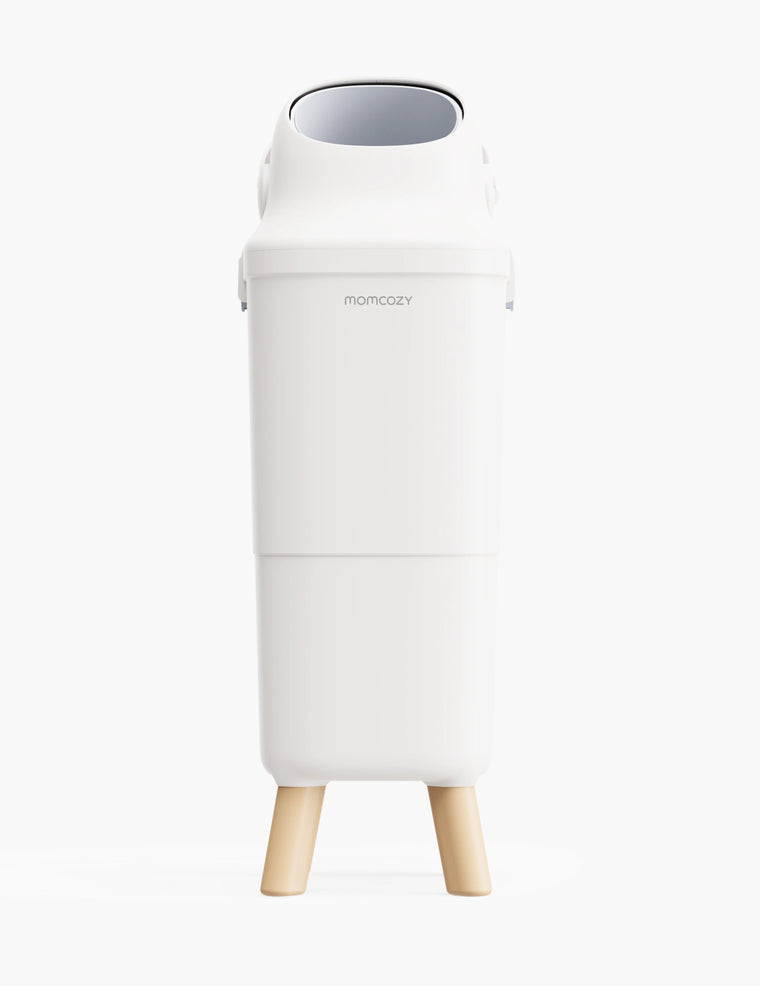
For families that want a dedicated nappy bin, the Momcozy Triple-Seal Nappy Bin is one example of a floor-level disposal option. The current UK product page lists Triple-Seal odour control, a wide opening, a child safety lock, 22L capacity and compatibility with standard 13-gallon bin bags, so there is no requirement for special refill bags.
Its value in a multi-storey home depends on the household setup, though. If you already have one central changing area and an easy route to the main household bin, buying a second dedicated bin may add more equipment without removing much effort.
If you are comparing nappy-bin options more broadly, see the Momcozy UK Nappy Bin collection and buying guide, which covers considerations such as odour containment, bag systems, capacity, footprint, emptying and running costs.

Three Multi-Storey Setups That Can All Work
There is no single correct arrangement for every two-storey home. These three examples show how the same household problem can have different solutions.
|
Household pattern |
Changing setup |
Disposal setup |
Why it can work |
|
Nursery upstairs, family downstairs all day |
Main downstairs station + compact upstairs/night station |
Main downstairs containment; small temporary option upstairs if needed |
Matches daytime and night-time zones without creating two full nurseries |
|
Most changes happen in the nursery |
One full upstairs station + portable mat or caddy downstairs |
One central nappy bin upstairs or direct route to the household bin |
Keeps most supplies and disposal in one place |
|
Frequent changes on both floors |
Well-stocked changing station on each floor |
Dedicated containment only where immediate disposal is inconvenient |
Reduces repeated stair trips without automatically doubling the number of bins |
The important point is that these are examples, not rules.
Your preferred arrangement may also change. A setup that feels useful during the newborn stage may become unnecessary later when changes become less frequent or your baby spends more time moving around the house.
Frequently Asked Questions
Do I need a changing station on every floor?
No. Add another changing station only if repeated trips between floors are genuinely interrupting your routine. A portable changing mat and small caddy can provide a useful secondary setup without requiring another full changing table.
Do I need two changing tables?
Not necessarily. The second floor usually needs the changing function, not a duplicate piece of furniture. A changing mat, caddy and a small supply of essentials can be enough.
If you already have a full station in the nursery, test a lighter downstairs setup before buying another table.
Do I need a nappy bin upstairs?
Only if it solves a real disposal problem. If upstairs changes are frequent and taking each used nappy to the main household bin means repeated inconvenient trips, a floor-level nappy bin may be useful.
If most changes happen downstairs or you can easily take used nappies to the main bin, a second dedicated bin may not be necessary.
Should the main changing station be in the nursery?
Not necessarily. The nursery is an obvious place for a changing station, but it may not be where most changes happen during the early months.
Look at where you and your baby actually spend time. If daytime life is mostly downstairs, a downstairs station may be more practical.
What should I keep at a downstairs changing station?
Start with the essentials you use regularly: nappies, wipes, a changing mat, regularly used clean-up supplies, a small number of spare clothes and a clear plan for used nappies.
You can keep larger stocks and less frequently used items at the main station upstairs.
When can I remove the second changing station?
There is no universal age when you need to remove it.
Instead, look at whether the secondary setup is still saving meaningful effort. If changes have become less frequent or your family now spends most of its time on one floor, you may be able to reduce the secondary supplies or remove the station altogether.
Conclusion
The best multi-storey nappy-changing setup is not the one with the most equipment. It is the one that puts the changing function close to where changes actually happen.
Start with one main station, then look at whether a second floor needs a complete setup or simply a changing mat, caddy and a few essentials. The same principle applies to nappy disposal: give every changing area a clear route for used nappies, but do not assume that every floor needs its own dedicated nappy bin.
If a second station saves repeated trips, keep it. If it creates more clutter and restocking work than it removes, simplify it. If you decide a dedicated nappy bin makes sense for one of your changing zones, the Momcozy Triple-Seal Nappy Bin is one option to consider for keeping used nappies contained close to the changing area.