If you have just changed your baby’s nappy and are staring at several different bins, the short answer is simple: used disposable nappies normally go in your household’s general or non-recyclable waste, not the standard recycling bin. The exact bin colour or container name depends on your local council. Recycle Now also advises that disposable nappies should currently go in the waste bin because household nappy recycling is not widely available.
That is where things can get confusing. One council may use a black bin, another a grey bin, and another may use a purple-lidded non-recyclable bin or black sacks. So, rather than memorising a bin colour, learn the waste category first and then check your council’s local instructions.
If you are looking for a convenient way to keep used nappies during night time nappy changes contained indoors before they go into your household waste, you can also explore nappy bins. A dedicated nappy bin is an optional part of the routine; it does not change the final waste stream.
Key Takeaways
- Used disposable nappies normally belong in general or non-recyclable household waste.
- Do not put used disposable nappies in your standard household recycling bin.
- There is no single UK-wide bin colour for nappies. Your council may use black, grey, purple-lidded bins, black sacks or communal refuse containers.
- Some councils have specific instructions about bagging, tying or double-bagging used nappies.
- A nappy labelled biodegradable does not automatically mean it can go in a food, garden or composting collection.
- If your household produces a large amount of nappy waste, your council may offer additional or larger general-waste capacity, but eligibility varies.
- A dedicated indoor nappy bin is optional. It can make temporary storage easier, particularly in flats, upstairs changing areas or during night-time changes.
- Your local council’s waste guidance is the final check whenever you are unsure about your bin, collection or any specialist service.
Quick rule: Think general/non-recyclable waste, then check your council for the exact bin colour, bagging instructions and collection arrangements.

What Bin Do Nappies Go In in the UK?
For most UK households, a used disposable nappy should go into the general waste or non-recyclable waste stream. The exact name of that waste stream can vary. One council might call it general waste, another might use non-recyclable waste, while a household in a flat might simply have access to a communal refuse bin.
Recycle Now gives the national consumer-facing answer: disposable nappies should be placed in the waste bin, because recycling services for disposable nappies are not widely available to householders.
Current guidance in England also separates nappies from the dry recycling stream. Under the Simpler Recycling guidance, absorbent hygiene products, including nappies, are among the materials that do not need to be collected as paper and card or dry recyclables.
A simple disposal decision
|
Item or situation |
Where does it usually go? |
Important point |
|
Used disposable nappy |
General/non-recyclable waste |
Check your council's specific instructions |
|
Used disposable nappy in a recycling bin |
Remove it from recycling |
It should not normally be placed in standard household recycling |
|
Nappy with a “biodegradable” label |
Do not assume it can be composted |
Check whether your council accepts it in an organic or specialist collection |
|
Clean outer nappy packaging |
Check the material and local recycling rules |
Packaging is separate from the used nappy |
|
Household with a specialist nappy collection |
Use the specialist service |
Follow the scheme's bagging and collection instructions |
|
Nappies in a flat with communal bins |
Use the designated refuse/general-waste container |
Check the building or council's instructions |
The important distinction is that “general waste” is a waste category, not a single bin colour. That is why simply telling every UK parent to “put nappies in the black bin” can be misleading. Some councils do use black bins. Others do not.
Why “Black Bin” Is Not a Universal UK Rule
One of the biggest reasons parents search for “what bin do nappies go in?” is that bin colours can change when you move house.
You might have previously lived somewhere with a black general-waste bin. After moving, you could find yourself with a grey refuse bin, a purple-lidded bin or a communal waste system. The nappy itself has not changed. The local waste system has.
For example, councils use different approaches to non-recyclable household waste. Barnet refers to black or grey refuse bins for waste that cannot be recycled, while its sack system can use black or purple non-recycling sacks depending on the property and collection arrangements.
This is why it is better to remember: Nappies belong in your council's general/non-recyclable waste stream — not “the black bin” specifically.
How councils can label the same waste stream
You might come across:
- Black general-waste bins
- Grey refuse bins
- Black non-recycling sacks
- Purple non-recycling sacks
- Communal refuse bins
- A separate local nappy or absorbent-hygiene collection
These names can make the same basic question feel much more complicated than it needs to be.
What should you do if you have just moved?
If you have moved to a new council area, do not rely on the instructions from your previous home.
Instead:
- Search for your local council's waste and recycling page.
- Look for its household waste A–Z guide.
- Search specifically for “nappies”.
- Check whether your council has any bagging or collection requirements.
- If you live in a flat, check whether your building has separate instructions for communal bins.
You can also use the UK government's recycling collection service to find your local council's recycling information in England and Wales.
What about flats and communal bins?
The same principle applies if you do not have your own wheelie bins. A communal refuse area might have large shared bins instead of individual household containers. Current English household recycling guidance specifically recognises that flats and communal properties can use communal, on-site bins where appropriate.
So if you live in a block of flats, the question is not necessarily: “Is it the black bin?”
It is: “Which communal container is designated for general or non-recyclable household waste?”
If the signage is unclear, check with your managing agent, housing provider or local council rather than guessing.
Why Used Nappies Do Not Belong in Household Recycling
It can feel tempting to put a used disposable nappy into the recycling bin, especially when you are trying to reduce household waste.
But used disposable nappies are not standard household recyclables.
They contain a combination of materials, and once used, they are also contaminated. The North London Waste Authority explains that nappies contain natural and synthetic materials and cannot be recycled because of both their composition and hygiene concerns.
Sevenoaks District Council gives an even stronger practical warning: it says disposable nappies cannot be recycled and should be bagged and put with waste sacks. It also warns that a disposable nappy placed in recycling can result in the recycling load being rejected.
Used nappy vs nappy packaging
This is an important distinction. The used nappy is one waste item. The packaging it came in is another. So do not assume that because a nappy packet has a recycling symbol, the used nappy itself can go into the recycling bin. The packaging may have its own recycling instructions depending on its material and your local collection system.
A useful way to think about it is:
|
Item |
What to check |
|
Used disposable nappy |
Your general/non-recyclable waste rules |
|
Empty cardboard packaging |
Your paper/card recycling rules |
|
Plastic nappy packaging |
Your council's plastic-packaging guidance |
|
Nappy sacks |
Usually general waste, unless your council specifically says otherwise |
|
Used wipes |
Check your local waste guidance; do not flush them |
Why “wishcycling” is not helpful
“Wishcycling” is when something is put into the recycling bin because you hope it can be recycled, rather than because your local recycling service accepts it. With nappies, that can create a bigger problem.
If a recycling facility or collection crew does not accept nappies, putting one in the recycling stream does not give it a better chance of being recycled. It can instead introduce contamination into a collection that is intended for accepted recyclable materials.
The safer approach is simple: If the council does not specifically accept used nappies for recycling, keep them out of the recycling bin.
Can Nappies Go in Green, Brown, Food or Garden Waste Bins?
Generally, do not put used disposable nappies into food or garden-waste collections unless your council specifically tells you to do so. A green or brown bin does not automatically mean “anything biodegradable”.
This is particularly important if the nappy packaging uses words such as:
- Biodegradable
- Compostable
- Plant-based
- Eco
- Natural
- Sustainable
Those words may describe particular materials or product features, but they do not automatically mean that your local council's food or garden-waste facility accepts a used nappy.
Biodegradable does not automatically mean compostable
Think about the difference between: “This product has biodegradable materials.” and “My local council accepts this used product in its garden-waste collection.”
Those are two completely different statements. The second one is what matters when deciding which bin to use. Current English guidance also makes clear that certain materials labelled “compostable” or “biodegradable” are not automatically required to be collected in household recycling streams.
What if your council has a specialist scheme?
This is where local guidance becomes particularly important. Some areas are developing or operating specialist collections for nappies and other absorbent hygiene products.
For example, Neath Port Talbot Council operates a specific disposable nappy and absorbent-hygiene collection for eligible households, using dedicated purple bags rather than the normal black-bin route.
That does not mean every UK household should look for a purple nappy bag.
It means: If your council provides a dedicated nappy collection, follow that scheme instead of assuming the national general-waste route applies in exactly the same way.
Bagging, Tying and Double-Bagging: What Do Councils Actually Ask For?
Knowing which bin to use is only part of the question. You may also wonder, “Do I need to put the nappy in a bag first?” There is no single bagging rule for every UK household. Some councils provide specific instructions about tying or double-bagging hygiene waste. Others simply direct residents to put nappies into their general-waste sacks or refuse bins.
That means you should follow your council's instructions rather than assuming every nappy needs the same treatment.
A practical approach
If your local guidance says nappies should be bagged:
- Secure the used nappy appropriately.
- Place it in the required waste bag.
- Tie or close the bag if your council instructs you to.
- Put the bag into the correct general/non-recyclable waste container.
- Follow any limits on sacks or additional waste.
Some councils specifically provide guidance around bagging hygiene waste. For example, Sevenoaks says disposable nappies should be bagged and put with waste sacks.
Why might councils have different instructions?
Local waste systems differ. A council collecting refuse in a wheelie bin may have different requirements from a council using sacks. A communal-bin system can also work differently from an individual household collection. The collection frequency can matter too.
So if you have seen someone online say: “you always need to double-bag nappies or you never need to bag them”, do not automatically treat either statement as a nationwide UK rule.
Check your own council's instructions.
Do not confuse different types of bags
There are several different things parents may call a “nappy bag”:
- A small bag used to contain an individual nappy
- A bin liner used inside an indoor nappy bin
- A council-issued refuse sack
- A specialist bag supplied for a local hygiene-waste collection
They are not necessarily interchangeable. If your council gives you a specific bag for a specialist collection, use it according to the scheme's instructions.
From the Changing Mat to Collection Day: The Full UK Disposal Workflow
Once you separate immediate indoor containment from final council disposal, the whole process becomes easier to understand. The basic workflow looks like this. This is especially useful when you are still establishing your routines after bringing your baby home.
Step 1: Change the nappy
After the nappy change, secure the used disposable nappy according to your normal household routine. At this point, you have two separate decisions: “where can I safely contain it right now and which waste stream will it eventually go into?” They do not have to be in the same place.
Step 2: Contain it indoors if necessary
If your outdoor bin is directly outside the changing area, you may simply take the nappy out straight away. But that is not practical for every household.
You might live:
- On an upper floor
- In a flat
- In a multi-storey house
- In a home where the changing area is upstairs
- In a building with a communal waste area
- Somewhere where taking the bin out at night is inconvenient
In these situations, you may want a temporary indoor containment option. That could be:
- A regular lidded bin
- A small household waste bin
- A dedicated nappy bin
- Another suitable household arrangement
The important thing is that temporary indoor storage does not determine the final council waste category.
Step 3: Transfer the waste to the correct outdoor stream
When you are ready to empty your indoor container, the used disposable nappies should go into the waste stream specified by your council. For most households, this means general/non-recyclable waste. If your council has a specialist nappy collection, follow that service instead.
Step 4: Follow collection-day instructions
Check:
- Which container to use
- Whether bags need to be tied
- Whether the council limits the number of sacks
- When the waste should be presented
- Whether communal-bin users have different arrangements
- Whether your council offers extra capacity for households with high nappy use
This is where your local guidance matters most.
Different Homes, Different Indoor Nappy-Disposal Setups
There is no single indoor routine that works equally well for every family.
The final waste stream can stay the same while the route from the changing mat to the outside bin changes. For many parents, managing nappies is simply one part of establishing daily routines with a young baby.
Scenario 1: Flat or communal-bin home
If you live on the third or fourth floor and the communal bins are downstairs, taking a used nappy outside after every change may quickly become impractical. An indoor containment option can reduce those repeated trips.
The important distinction is:
- Indoor bin = temporary storage
- Council waste stream = final disposal
A dedicated indoor bin does not turn nappies into recyclable waste.
Scenario 2: Multi-storey house
A family might have:
- Changing facilities upstairs
- A bathroom upstairs
- A kitchen downstairs
- The main outdoor bin at the back of the property
In this situation, keeping a small lidded bin upstairs may make everyday changes easier. The contents can then be transferred to the household's general waste when appropriate.
Scenario 3: Night-time changes
Night-time changes can make distance particularly noticeable.If the outdoor bin is at the other end of the garden, you may not want to walk outside after every overnight change.
An indoor containment option can be useful simply because it reduces the number of trips you need to make. It does not need to be treated as a special waste-disposal system.
Scenario 4: Easy outdoor access
If your changing area is close to your outdoor bin, a dedicated nappy bin may add little value. You might simply secure the used nappy and take it outside as part of the normal household routine.
A simple scenario matrix
|
Home setup |
Possible indoor routine |
Final waste route |
|
Outdoor bin beside changing area |
Take waste outside after changes |
Council's general/non-recyclable stream |
|
Multi-storey home |
Small lidded or dedicated indoor bin |
Transfer to correct outdoor waste stream |
|
Flat with communal bins |
Temporary indoor containment |
Designated communal refuse/general-waste container |
|
Night-time changing upstairs |
Indoor containment until morning |
Correct council waste stream |
|
Specialist local collection |
Use council-provided system |
Specialist nappy/AHP collection |
|
Frequent outdoor access |
Direct disposal may be simplest |
Correct council waste stream |
The point is not to find the “best” setup for every family. It is to find the least complicated routine that works in your home while following your council's disposal rules.
What Changes When Several Children Are in Nappies?
One baby in nappies can already add a noticeable amount of waste to a household. With two children in nappies at the same time, the volume can become a practical issue. Nappies are also only one part of the baby essentials that families need to organise and manage at home.
This is particularly noticeable when:
- General-waste collections are less frequent
- The household uses a smaller refuse bin
- The family lives in a flat with limited storage
- Several children are still using disposable nappies
- Other non-recyclable household waste is also being generated
Some councils recognise that certain households may need additional waste capacity. But this is not a universal entitlement.
For example, Bath & North East Somerset Council's household collection guidance says households with two or more children in disposable nappies may be considered for additional storage. Other councils have their own eligibility systems.
If your general-waste bin keeps filling up
Do not assume that buying a larger indoor nappy bin will solve an outdoor council-capacity problem. An indoor bin only changes where the waste sits temporarily.
Instead, check whether your council offers:
- An additional refuse bin
- A larger refuse bin
- Extra refuse sacks
- A hygiene-waste collection
- A nappy collection
- A household capacity assessment
What evidence might your council ask for?
This varies. Some schemes may simply ask about household circumstances. Others may have eligibility criteria relating to the number of children, collection arrangements or other household needs.
The important thing is: Do not assume that every council will provide extra capacity just because a household uses nappies.
Check the local policy first.
Keeping General Waste Manageable Between Collections
Once you know that used disposable nappies normally belong in general or non-recyclable waste, the next challenge is managing that waste until collection day. This is where a simple routine can help.
Keep the waste stream clear
Do not use the general-waste bin for items that your council already collects for recycling. Separating recyclable materials correctly can help preserve the capacity you have for waste that genuinely belongs in the refuse stream.
Follow your council's bagging instructions
If your council says nappies should be tied or double-bagged, follow those instructions. If it does not require a particular bagging method, you do not need to create your own nationwide rule.
Keep outdoor waste secure
Where your council provides guidance on storing refuse before collection, follow it. For example, some councils specify where waste should be stored or when it should be put out.
Watch the real problem: capacity
If you repeatedly run out of space before collection day, ask: Is the problem the number of nappies, the collection frequency, or the household's overall waste volume?
That can lead to a more useful solution than simply buying a bigger indoor container.

What UK Parents on Reddit Actually Do
Official council guidance should always take priority when deciding where used nappies should ultimately go.
But real-parent discussions can be useful for understanding a different question: What is actually practical inside a home?
UK parents describe a range of routines depending on where they change their babies, how close their outdoor bins are and how often they want to make trips outside. Some households use an indoor bin for convenience, particularly when the changing area is upstairs or when going outside at night is inconvenient. Small changes to the way baby-care tasks are organised can sometimes help with making everyday life easier for new mums.
Others prefer to use a normal household bin and take waste outside regularly. There is also a practical split around when parents want certain nappies to leave the house. Some families are comfortable keeping wet nappies in an indoor bin for a period but prefer to take soiled nappies outside sooner. Others use the same indoor arrangement for both.
These are household preferences, not official disposal rules.
Why home layout matters
A routine that works in a detached house may feel completely different in a top-floor flat.
For example:
|
Situation |
Why the routine may differ |
|
Changing table next to back door |
Direct outdoor disposal is easy |
|
Changing area upstairs |
Temporary indoor storage may be more convenient |
|
Top-floor flat |
Repeated trips downstairs can be impractical |
|
Communal bins far from the flat |
Household may prefer fewer disposal trips |
|
Night-time changes |
Indoor containment can reduce unnecessary trips |
|
Multiple children |
More frequent emptying may become necessary |
The useful lesson from these discussions is not that one type of bin is universally better. It is that the right indoor routine depends heavily on household layout and personal preference.
What Reddit cannot tell you
Reddit can show what individual parents do.
It cannot tell you:
- Which bin your council requires
- Whether your council accepts a specialist nappy collection
- Whether you qualify for extra capacity
- Whether a particular bagging method is mandatory
- What happens to your council's waste after collection
So use community discussions for practical ideas, not municipal waste policy.
Frequently Asked Questions
Can baby wipes go in the same general-waste bin as used nappies?
Used wipes are generally treated as non-recyclable waste, but local collection rules can vary. The important point is never to flush wipes simply because they are described as flushable. Check your local council's waste guidance for the correct disposal route.
If your council operates a specialist absorbent-hygiene collection, check whether wipes are included. Some specialist schemes do include them; others do not. For example, Neath Port Talbot's dedicated nappy and absorbent-hygiene service includes disposable nappies and wipes.
Can nappy packaging go in recycling?
Possibly, depending on the material and your local recycling service. The packaging should be treated separately from the used nappy.
Check:
- What material the packaging is made from.
- Whether your council accepts that material.
- Whether it needs to be clean and empty.
- Which recycling container your council uses for it.
Do not use the recycling symbol on packaging as proof that every part of the product can go into your recycling bin.
What if my council has a specialist nappy collection?
Use it according to the council's instructions. Specialist schemes can have their own:
- Bags
- Collection days
- Eligibility requirements
- Storage containers
- Accepted items
For example, Neath Port Talbot provides dedicated purple bags for eligible disposable nappy and absorbent-hygiene waste. This is why local guidance should always take priority over a general UK rule.
Why does one council say grey bin and another say black bin?
Because bin colours are determined locally. A black bin in one council may represent general waste, while another area may use grey bins, sacks or communal refuse containers.
The more reliable rule is: Identify the general/non-recyclable waste stream first, then check the local container colour.
Do I need a special indoor nappy bin?
No. There is no general household-waste rule requiring parents to own a dedicated indoor nappy bin. Your options depend on your home and routine. You may find that a regular lidded bin is enough, particularly if the outdoor bin is easy to reach.
A dedicated nappy bin may be more useful if you:
- Change nappies upstairs
- Live in a flat
- Have night-time changes away from the kitchen
- Want to reduce repeated trips outside
- Prefer a dedicated place for used nappies
If you are considering one, you can explore nappy bins as an optional indoor-containment solution.
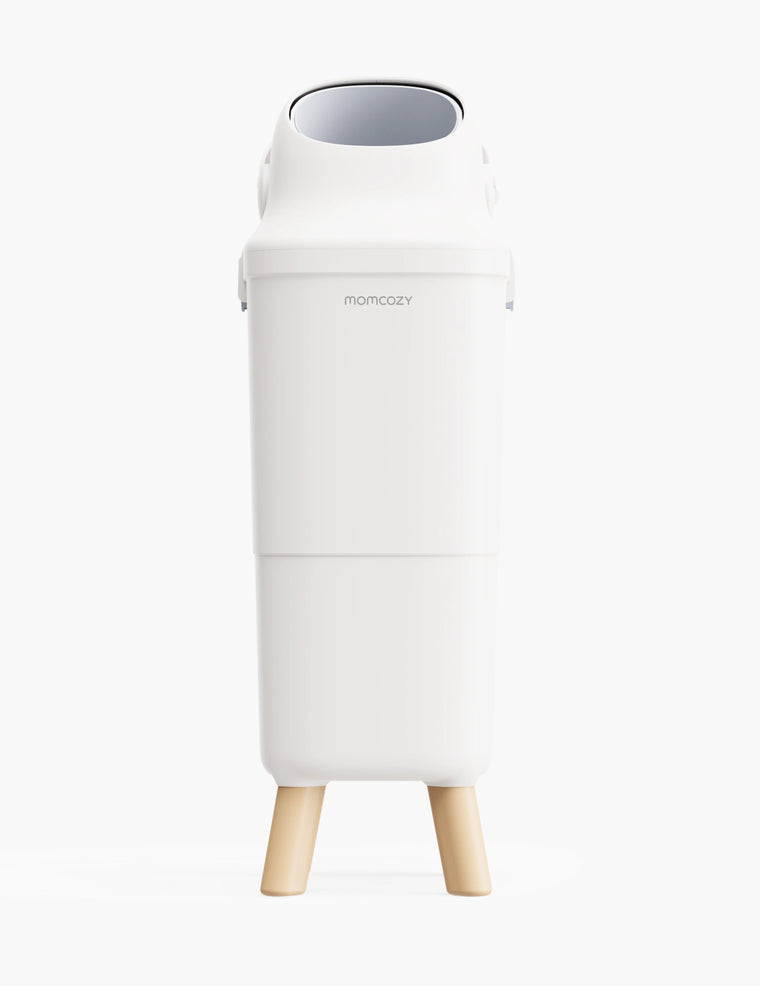
What about a dedicated nappy bin such as the Momcozy Triple-Seal Nappy Bin?
A dedicated nappy bin is an indoor containment option, not a different municipal waste category.
The Momcozy Triple-Seal Nappy Bin is designed for indoor nappy disposal and includes features such as a triple-seal odour-control design, a 22L capacity, a wide opening and a child safety lock.
Those features may be relevant if you want a dedicated container in a changing area, but the bin itself does not change where the used nappies ultimately belong.They still need to be transferred into the waste stream specified by your local council.
What if I have twins or two children in nappies?
You may need to check whether your council offers additional waste capacity. Some councils have specific arrangements for households with several children in disposable nappies, while others assess requests individually. Do not assume you automatically qualify.
Search your council's website for terms such as:
- Additional bin
- Larger refuse bin
- Extra waste capacity
- Nappies
- Hygiene waste
- Household waste support
Do nurseries and care facilities use the same disposal rules as households?
Not necessarily. This article focuses on domestic household waste.
Nurseries, childminders, care facilities and other organisations may have different waste arrangements or commercial waste responsibilities.
For example, Neath Port Talbot explicitly states that registered childminders and nurseries fall under its Trade Waste Service rather than the household nappy collection. If you are disposing of nappies as part of a business or organisation, check the relevant commercial waste guidance instead.
A Quick UK Nappy Disposal Checklist
Before throwing away your next used disposable nappy, ask:
1. Is it a used disposable nappy?
→ Treat it as non-recyclable household waste unless your council provides a different specialist route.
2. Am I about to put it in recycling?
→ Stop. Used nappies do not normally belong in standard household recycling.
3. What colour is my general-waste container?
→ Check your council rather than assuming it must be black.
4. Does my council require nappies to be bagged or tied?
→ Follow the local instructions.
5. Does my council have a specialist nappy collection?
→ If yes, follow that scheme's rules.
6. Am I confused because the nappy says “biodegradable”?
→ Check whether your council actually accepts it in an organic or specialist collection.
7. Am I using an indoor nappy bin?
→ Remember that it is temporary containment. The final council waste stream stays the same.
8. Does my household regularly run out of general-waste capacity?
→ Check whether your council offers additional capacity for households with children in nappies.
What If You Are Still Not Sure Which Bin to Use?
If you have checked your bins and still cannot work out where used nappies belong, do not guess based on the colour. Use this three-step check:
1. Identify your council
Your waste collection service is normally managed according to your local authority area.
2. Search its waste A–Z
Look specifically for nappies rather than searching only for recycling This can take you directly to the council's item-specific instructions.
3. Look for exceptions
Check whether the council mentions:
- Specialist nappy collections
- Absorbent-hygiene collections
- Bagging requirements
- Communal-bin arrangements
- Additional capacity
- Collection restrictions
This final step matters because the general UK answer may have a local exception.
Conclusion
So, what bin do nappies go in in the UK? For most households, the answer is general or non-recyclable household waste. Used disposable nappies should not normally be placed in standard household recycling, and Recycle Now currently directs householders to put them in the waste bin.
What you should not assume is that this always means a black bin. Your council may use a black or grey refuse bin, sacks, communal containers or a dedicated local collection. Some councils are also introducing or operating specialist nappy and absorbent-hygiene services.
The easiest rule to remember is to think of the waste category first, bin colour second. If you need somewhere to contain used nappies indoors before collection, a regular lidded bin may be enough for some households, while others may prefer a dedicated nappy bin. Whichever indoor setup you choose, the final step is the same which is follow your local council's instructions for the correct waste stream, bagging and collection.