What Bin Do Nappies Go In?
Used disposable nappies normally go in your household general waste or non recyclable waste bin, not standard household recycling. However, there is no single bin colour used across the UK, so the correct container depends on your local council.
This means that some areas may put their nappies into a black bin, others in a grey bin, while some might have a purple lidded non recyclable waste bin. If you’ve recently moved house, or if you’re living in a flat with communal bins, or you just want to double-check your local council’s rules on what goes where, make sure you consult your household waste guidance from your council before putting those nappies out.
If you’ve recently brought your baby home, figuring out where nappies should go is just one of the practical routines you’ll need to establish. For more guidance on those first days, see our guide on bringing your baby home from hospital.
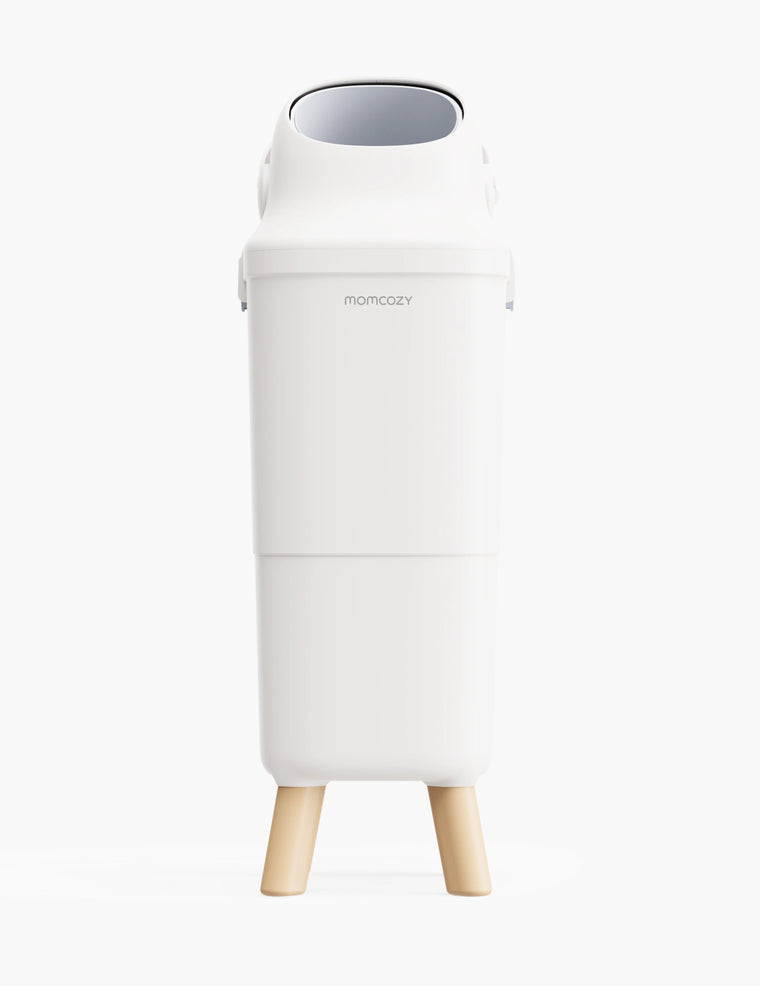
For temporary indoor storage between changes and collection day, you can also explore nappy bins as an optional part of your setup. For example, you can use your ‘Momcozy Triple Seal Nappy Bin’ as a way of containing the used nappies within the home before transferring them to the relevant domestic waste-stream.

Key Takeaways
- Used disposable nappies normally belong in general or non recyclable household waste, not standard household recycling.
- The correct bin colour varies between councils, so do not assume that every UK household uses a black bin.
- Some councils use grey bins, black sacks, purple lidded bins or communal refuse containers for general waste.
- Used nappies should not normally go into recycling because they contain mixed materials and are contaminated after use.
- A nappy labelled biodegradable does not automatically mean it can go into a food or garden waste bin.
- Some councils have specific requirements for tying or double bagging nappies.
- Families with several children in nappies may be able to request additional waste capacity in some areas, subject to local eligibility.
- An indoor nappy bin can make temporary storage easier, but it does not change the final council waste category.
What Bin Do Nappies Go In in the UK?
The simplest answer to this is – put them in with your normal general waste / non recyclable waste stream. National recycling guidance recognises disposable nappies as waste, not standard household recycling and council guidance (across different areas of the UK) has followed this with a similar ‘general category’.
The confusing part is what that waste stream looks like at home. Your council may use a black bin, grey bin, black sack, purple lidded bin or communal refuse container. These are different local systems for managing household waste, rather than evidence that nappies have a different national disposal category.
|
Item or situation |
Usually goes where? |
Important caveat |
|
Used disposable nappy |
General or non recyclable waste |
Check your council's specific instructions |
|
Used nappy placed with recycling |
Not standard recycling |
Remove it from the recycling stream and follow local general waste guidance |
|
Biodegradable labelled disposable nappy |
Usually general waste |
Do not assume biodegradable means garden or food waste |
|
Outer nappy packaging |
Potentially recycling |
Check the packaging material and your council's accepted items |
|
Area with a specialist nappy scheme |
Follow the specialist scheme |
Local schemes have their own collection instructions |
If you are standing beside the changing mat with a used nappy in your hand, the practical decision is therefore simple: identify your council's general or non recyclable waste container.
If you are unsure, search your council's website for its waste A to Z or household bin guidance. A useful search is:
[Council name] + nappies + waste
This is more reliable than searching for a particular bin colour.
Why “Black Bin” Is Not a Universal UK Rule
A black bin is commonly associated with general waste, but it is not a nationwide rule.
Council systems differ. For example, Renfrewshire has a gray bin or black bag for general waste and diapers are included in that stream. East Herts’ purple lidded bin is for non recyclable waste including diapers and wipes. Other councils have black bags or black bins.
This matters if you move house or regularly use communal bins.
Imagine moving from an area where nappies went into a black bin to another council where the general waste container is grey. The colour has changed, but the waste category has not.
How Councils Label the Same Waste Stream
Different councils may describe the relevant container as:
- General waste
- Non recyclable waste
- Refuse
- Household rubbish
- Black bin waste
- Grey bin waste
- Black sacks
- Communal refuse
The transferable rule is therefore category over colour.
If your council provides a purple lidded bin for non recyclable waste, use that. If it provides a grey bin, use the grey bin. If you live in a flat and have communal refuse bins, follow the signage and instructions provided for that waste stream.
What to Do in Flats With Communal Bins
Communal bin areas can make the decision less obvious because you may not have the same coloured containers as a house.
Look for labels indicating general waste, refuse or non recyclable waste. If the bins are not clearly marked, check your council's guidance or ask your building management team which communal container is designated for household refuse. If you are also setting up your baby's sleeping and changing areas in a smaller home, our guide on how to arrange a bassinet in your bedroom offers practical ideas for organising the space safely and comfortably.
Do not rely solely on what you remember from a previous address.
Why Used Nappies Do Not Belong in Household Recycling
Used disposable diapers should not normally be placed in your household recycling bin.
A disposable nappy is made of a number of materials, and is contaminated with bodily waste after use. The resulting mixture cannot be recycled through conventional household recycling systems. The council and waste authority's guidance warns that putting diapers in recycling can contaminate the recycling stream and potentially lead to collections being rejected.
Used Nappy vs Nappy Packaging
It is important to separate the used nappy from its packaging.
The packaging may have a recycling route depending on its material and your council's accepted items. The used nappy itself is a different waste item.
Seeing a recycling symbol somewhere on the packaging, does not mean the used nappy should be put in the recycling bin.
If you are unsure about the packaging, check your council’s recycling guidance separately.
Why “Wishcycling” Can Make the Problem Worse
It is understandable to want to recycle as much as possible, particularly when caring for a baby creates a large amount of household waste.
But just because something looks recyclable, putting it in the recycling bin can present problems if the local system can’t handle it. Sometimes it's called wishcycling.
In the case of used diapers, the sensible option is to remain within the waste category accepted and not to seek a recycling route unsupported by your household collection.
Some areas may have specialist nappy recycling schemes, but these are not to be confused with standard curbside recycling.
Can Nappies Go in Green, Brown, Food or Garden Waste Bins?
Don’t put disposable diapers in your food or garden waste unless your council has told you they are accepted.
The color of a bin does not tell you what to put in it. More importantly, a product labeled as biodegradable does not automatically go into the organic waste collection.
For example, Milton Keynes' guidance excludes disposable and biodegradable diapers from its garden waste route, sending them to black general waste. Renfrewshire also diverts its diapers from its brown food and garden waste stream.
Biodegradable Label vs Accepted Council Waste Stream
“Biodegradable” describes a characteristic of a product. It does not tell you what your local waste collection is equipped or authorised to accept.
Before placing a biodegradable labelled nappy into an organic waste bin, check whether your council explicitly accepts that type of product.
Unless it does, use the council's stated general or non recyclable waste route.
Bagging, Tying and Double Bagging: What Do Councils Actually Ask For?
Once you know which bin to use, you may still need to check how your council wants nappies prepared.
Instructions vary. Some councils simply direct nappies into general waste, while others provide specific instructions about tying bags or double bagging. Dudley and Milton Keynes, for example, include double bagging guidance, while Peterborough and Cheshire East provide tied bag instructions.
When a Tied Bag Is Enough
If your council says that nappies should be placed in a tied bag, follow that instruction rather than creating your own disposal system.
The requirement may apply particularly to households using sack based collections or particular waste services.
Why Local Instructions Differ
Waste collection systems are designed differently from one council to another. Collection frequency, container type, handling procedures and local waste policies can all affect household instructions.
For that reason, there is no need to create a nationwide rule saying that every used nappy must be individually wrapped or double bagged.
Follow the instructions for your own collection service.
Also remember that a nappy sack, an indoor nappy bin liner and a council general waste sack are not necessarily the same thing.
From the Changing Mat to Collection Day: The Full UK Disposal Workflow
Once you separate the immediate changing task from the final waste destination, nappy disposal becomes much easier to understand.
Step 1: Contain After the Change
After changing your baby, contain the used nappy according to your household routine and any relevant local guidance.
The important point is that temporary indoor containment and final council disposal are two separate decisions.
Step 2: Temporary Indoor Storage
If your outdoor or communal waste bin is easy to reach, you may choose to take the nappy directly outside.
If the bin is downstairs, outside the building or some distance from the changing area, temporary indoor storage can be more practical.
Some families use a regular lidded bin, while others choose a dedicated nappy bin.
The right indoor setup depends on the layout of your home and your routine. If you are adjusting to those first few weeks with a newborn, our guide to caring for your 5-week-old newborn covers everyday routines including sleep, feeding and soothing.
Step 3: Transfer to Council General Waste
When your indoor container needs emptying, move the waste into the council approved general or non recyclable waste stream.
This is where local guidance matters. Follow any requirements around bags, tying or double bagging.
Step 4: Collection Day
Put the waste out according to your council's collection instructions.
Your indoor container does not change the council category. It simply provides somewhere convenient to hold used nappies before collection.
If you are considering the Momcozy Triple Seal Nappy Bin as an indoor option, its verified product information includes a 22L capacity, wide opening, standard 13 gallon trash bag compatibility and child safety lock. These are indoor containment features, not changes to municipal waste rules.
Different Homes, Different Indoor Nappy Disposal Setups
The final waste category can remain the same even when the best household routine looks completely different.
Flat or Communal Bin Home
If the communal bins are downstairs or outside the building, taking every used nappy out immediately may become inconvenient.
Some UK parents discussing their routines on Reddit describe using an indoor kitchen or dedicated bin and emptying it later. These comments are useful for understanding household friction, but they do not establish official waste policy.
Multi Storey Home
A changing area upstairs can create a similar issue.
Instead of carrying every nappy downstairs immediately, some households use temporary indoor containment and transfer the waste later.
The practical question is not whether the nappy belongs in a different waste category upstairs. It does not. The question is simply how you want to move it from the changing area to the correct outdoor waste stream. As your baby grows, your household routines will naturally change as well. You can also explore our guide to parenting an 11-week-old infant for more ideas on adapting to this stage.
Night Time Changes
Night changes can make distance particularly noticeable.
A parent may prefer temporary containment near the bedroom rather than walking downstairs after every change. Again, this is a household workflow decision, not a different disposal rule.
House With Easy Outdoor Access
If the general waste bin is immediately outside the door, a dedicated indoor nappy bin may add little value.
Some households may prefer taking used nappies directly outside, particularly during the day.
The best setup is therefore the one that reduces unnecessary friction while keeping the final waste destination correct.
What Changes When Several Children Are in Nappies?
Having two or more children in nappies can turn an ordinary household waste container into a genuine capacity issue.
Some councils recognise this. Warwick, for example, may provide larger or additional bin capacity for households with two or more children in disposable nappies for a limited period, subject to its criteria. Dudley and West Northamptonshire also have local arrangements concerning additional capacity or household waste needs.
When to Check for Extra Capacity
Consider checking your council's policy if:
- Several children are currently using disposable nappies.
- Your household regularly fills its general waste container before collection day.
- You are using a three weekly or otherwise infrequent collection service.
- You have another locally recognised household waste capacity need.
What Evidence or Eligibility May Be Local
Do not assume that having a baby automatically qualifies a household for a larger bin.
Councils may apply different eligibility rules, time limits or application requirements.
Search your council's website for additional bin capacity, extra waste, nappies or hygiene needs.
An indoor bin's capacity is a separate issue. A larger indoor container does not increase the capacity of your council supplied outdoor bin.

Keeping General Waste Manageable Between Collections
Once you know what waste stream you’re dealing with, the next challenge can be managing it until collection day.
Follow your council’s instructions for bagging and storing household waste and keep it securely contained.
Some council guidance recommends tied or double bagged nappies in particular circumstances, while other services may have different requirements.
If your main concern is persistent odour from an indoor nappy bin, that is a separate question from which council waste stream nappies belong in. Likewise, detailed cleaning or maintenance advice belongs in a dedicated guide rather than this disposal classification article.
The same principle applies to capacity: if you consistently run out of outdoor bin space, check your council's local support or additional capacity policy rather than assuming an indoor bin will solve the issue.
What UK Parents on Reddit Actually Do
Official council guidance tells you where used nappies should ultimately go. Parent discussions can provide a different type of information: what people actually find practical inside their homes.
A UK Reddit discussion reviewed for this article showed several different approaches, including regular indoor bins, dedicated nappy bins, nappy sacks and taking some nappies outside sooner.
Why Pee and Poo Nappies Often Follow Different Routines
Several commenters described treating wet and soiled nappies differently, with some preferring to move poo nappies outside sooner while keeping wet nappies in an indoor bin temporarily.
This should be understood as individual household preference rather than official disposal guidance.
When a Dedicated Indoor Bin Helps
A dedicated bin can make sense when:
- The changing area is far from the outdoor bin.
- You regularly change nappies upstairs.
- You want temporary containment between collections.
- Night time trips downstairs are inconvenient.
- You prefer keeping nappy disposal separate from other household waste.
When a Regular Lidded Bin May Be Enough
A dedicated nappy bin may be unnecessary if:
- Your main bin is close to the changing area.
- You already have a suitable lidded household bin.
- You take used nappies outside regularly.
- You do not want another container in the changing area.
- Your household produces relatively little waste between collections.
The Reddit discussion also included objections around refill costs and preferences for simpler containers. These are useful considerations when choosing a household routine, but they do not determine the correct council waste stream.
Frequently Asked Questions
Can baby wipes go in the same general waste bin as used nappies?
Several council waste guides group disposable wipes with general or non recyclable waste. However, local rules should always be checked because collection systems differ. Do not treat this as permission to flush wipes down the toilet.
Can nappy packaging go in recycling?
The used nappy and its packaging should be treated as separate waste items. Check the packaging material and your council's accepted recycling list to determine whether the packaging can be recycled.
What if my council has a specialist nappy or absorbent hygiene collection?
Follow that scheme's instructions. Specialist routes may be available in some areas, but they are not the standard household disposal route across the UK.
Why does one council say grey bin and another say black bin?
Bin colours are determined locally. One council may use a grey bin for general waste while another uses black, purple lidded or sack based systems. The important part is identifying your council's general or non recyclable waste stream.
Do I need a special indoor nappy bin before collection day?
No. Household waste rules determine where the used nappy ultimately goes, not which indoor container you use first.
A regular lidded bin, dedicated nappy bin or direct outdoor disposal may all form part of different household routines. Choose according to your home's layout and your collection routine.
Do nurseries and care facilities use the same disposal rules as households?
Not necessarily. Organisational settings can have different waste management arrangements and responsibilities. This guide focuses on domestic household disposal rather than commercial nursery or care facility waste.

Conclusion
So, what bin do nappies go in in the UK?
Used disposable nappies normally belong in your household general or non recyclable waste, rather than standard household recycling. The important caveat is that the bin colour is not standard across the UK.
Your local council may use a black bin, grey bin, black sack, purple lidded container or communal refuse bin for the relevant waste stream. Some councils also have specific requirements for bagging, collection or additional waste capacity.
When in doubt, check your council's waste A to Z or household bin guidance. Think waste category first, bin colour second.
For the indoor part of the routine, a dedicated nappy bin can provide temporary containment before collection, but it does not change the final council waste stream. The simplest setup is the one that works with your home's layout while following your local waste rules. If you are also looking for ways to manage the cost of everyday baby essentials, our guide to free baby stuff and baby essentials covers ways parents can look for useful items and savings.