There is no single "best nappy bin" that suits every UK household. The right choice comes down to how long nappies sit indoors before they're emptied, how often you're prepared to change the bag, whether you want standard liners or a proprietary refill system, how much space you have, and how easily the bin operates with one hand. Rather than chasing a "best overall" pick, it helps to compare nappy bins by the factors that actually change day-to-day ownership, not just the marketing claims on the box.
This guide walks through those factors in order, starting with your household's disposal routine and building up to a simple scorecard you can use before you buy.
Key Takeaways
- The best nappy bin is the one that fits how long nappies stay indoors, how often you empty them and which trade-offs matter most.
- Odour-control claims are easier to compare when you look at the sealing mechanism, what happens during opening and how stored waste is isolated.
- Proprietary refill cassettes can add ongoing cost and replacement dependency, while standard-liner systems trade that restriction for a different containment mechanism.
- Capacity should be considered alongside nappy size, household space and emptying frequency because a larger bin can reduce bag changes but keep waste indoors longer.
- One-handed operation, opening height and emptying method can affect everyday convenience as much as headline capacity or the initial purchase price.
- Flats, upstairs nurseries and homes with inconvenient outside bins usually place more value on indoor containment than households that empty nappies immediately.
- A regular lidded bin can still be sufficient when frequent emptying is easy, so a dedicated nappy bin should solve real household friction.
Start With Your Disposal Routine, Not the Product List

Before comparing bins, it's worth working out how nappies actually move from the changing area to your household waste. This determines whether a specialised containment system is worth paying for at all.
Four questions to answer before comparing models
- How far is the outside or communal bin from where you change your baby?
- Would you rather empty a bin daily, every few days, or only when it's full?
- Do most changes happen upstairs, in a flat, in a bedroom or near an easy exit?
- Are you still deciding whether a dedicated bin is necessary at all?
Your answers will shape most of the decisions in this guide, from how much to prioritise sealing to whether a larger bin is worth the floor space.
When a small regular bin may already be enough
If you're happy to empty a small lidded bin after every change and the outside bin is close by, a specialised nappy bin may add cost without adding much practical benefit, particularly in the newborn stage when nappies are small and low-odour. If you're still weighing this up, our guide on do you need a nappy bin? covers that decision in more depth.
Compare Odour Containment by How the Bin Seals
"Odour control" is best treated as a mechanism and usage question rather than a marketing adjective. Reviews and UK parent discussions repeatedly treat odour performance as a top selection factor, but they're also consistent that no system should be described as completely smell-proof in every situation.
Closed-bin containment vs smell released during opening
Tight lids, internal seals, twist-and-wrap systems, clamps and airlock-style designs differ in two moments: what happens once closed for hours, and what happens the instant it's opened again for the next disposal. A bin can perform well in the first scenario and still release a noticeable smell in the second, so it's worth considering how much stored waste is exposed during that next action.
Why "odour-proof" should not be read as "zero smell forever"
Material and cleanability can play a supporting role, but it's not accurate to say steel is always better than plastic, or that a particular finish guarantees performance on its own. Odour control depends far more on the seal design and how consistently it's used than on the material the bin is made from. If odour is already an ongoing problem with your current bin, our article on how to stop a nappy bin smelling covers diagnosis and troubleshooting in detail.
Check the Bag System Before You Check the Price Tag
The recurring liner system can change your day-to-day experience of owning a nappy bin more than the upfront price does. This is one of the most common sources of frustration raised in UK parent discussions.
|
System |
What you're paying for |
Trade-off |
|
Proprietary cassette or refill |
A closed refill mechanism designed specifically for that bin |
Convenient once loaded, but you're tied to buying that brand's refills |
|
Standard liners or normal bin bags |
Flexibility to buy liners wherever you already shop |
Usually needs a slightly different fitting step, and containment depends more on the bin's design than the bag itself |
Proprietary cassettes: what you are paying for
A cassette or cartridge system typically wraps and seals each nappy individually as it's dropped in. The trade-off is ongoing dependency: replacements need to be bought specifically for that model, and availability or price can vary depending on where you shop.
Standard liners: flexibility without assuming identical performance
Bins designed for standard bin bags remove that dependency, though fitting a new bag may involve an extra step specific to that system. Cassette-free doesn't automatically mean better odour performance; it's a trade-off between consumable flexibility and the specific sealing mechanism used. For a fuller breakdown of refill costs over time, see our guide to nappy-bin refills and cartridges.
Capacity Is Really an Emptying-Frequency Decision
Capacity is best treated as an emptying-frequency and space-fit decision, not a "bigger is always better" specification contest.
Small vs large nappy bins: what changes in everyday use?
|
Household situation |
A smaller bin may suit |
A larger bin may suit |
What to verify |
|
Compact nursery or bedroom, happy to empty often |
Yes, less floor space used |
Less ideal, takes up more room |
External footprint and lid clearance |
|
High-frequency newborn changes |
Requires more frequent emptying |
Fewer bag changes overall |
How litre capacity relates to nappy size |
|
Multiple children in nappies |
May fill too quickly |
Reduces how often you empty it |
Whether waste stays indoors longer as a result |
|
Easy access to an outside bin |
Fine, since indoor storage time is short anyway |
Not essential |
Whether the extra capacity is actually needed |
How much capacity do you actually need?
Newborn frequency, nappy size, starting solids, and having more than one child in nappies can all change how quickly the same litre capacity fills up. There isn't one figure that applies to every household, which is why capacity is worth thinking about as a routine question rather than a single number to shop for.
Why "holds X nappies" is only an estimate
Competitor "holds X nappies" figures commonly assume newborn or size-1 nappies packed in a specific way. Treat these numbers as conditional estimates rather than universal facts, since actual fill rate depends on nappy size, stage and how tightly nappies are packed.
Nursery fit: capacity vs floor space
For a nursery, it's worth checking the external footprint, the clearance needed to open the lid, and the route to the changing area, not just the headline litre figure.
Test the Disposal Motion: One Hand, Height and Number of Steps

A bin that looks simple on a product page can feel very different during a real nappy change. It helps to count the actions involved, from holding the used nappy to having the bin sealed again.
Count the steps from "used nappy" to "sealed bin"
Look at the opening and closing method: does a hand need to stay on a handle, is twisting or pushing required, and does the lid return to a sealed state on its own? These small details add up over dozens of changes a week.
Why one-handed use is more than a convenience label
One-handed use comes up repeatedly in reviews and UK parent discussions, largely because the caregiver is often managing a wriggly baby with the other hand at the same time. Height and bending can add to daily friction too, though this is a practical consideration rather than a medical one, and no nappy bin should be relied on to replace close supervision during a nappy change.
Do Not Ignore Emptying and Cleaning
The selection decision should include what happens once the bin is full, since bag removal and exposure to stored waste often shape overall satisfaction more than how the bin performs freshly emptied.
What happens when the bin is full?
Check how the bag is closed off or removed, and whether you'll need to handle a long section of exposed liner. Some systems tie or seal the bag automatically, while others require you to gather and knot a standard bag yourself.
Cleaning access as a buying criterion
Look for smooth, accessible surfaces, and check what the manufacturer says can be wiped down or rinsed. Treat easy emptying and cleaning access as purchase criteria among several, rather than a full maintenance routine to plan around here.
Let Your Home Layout Change the Priority Order

The same bin can be genuinely useful in one home and unnecessary in another, mainly because the distance to your household bin changes how long nappies need to stay indoors before they're removed altogether.
Flat or communal-bin household
If you live in a flat or share a communal bin, nappies may need to be stored indoors for longer before a trip downstairs or outside, which raises the value of stronger containment and a bin that copes well with several days of storage rather than just a few hours.
Upstairs nursery or night-time changing
Changing upstairs or during the night adds real value to having disposal right next to the changing area, so you're not carrying a used nappy through a dark house or down a flight of stairs. Our guide to night-time nappy changes covers setting up that wider routine.
Easy outside-bin access
If your outside bin is close and easy to reach, it's reasonable to prioritise a smaller or simpler setup instead of paying more for maximum containment you may rarely need.
Add Child Access and Placement to the Buying Checklist
As a baby becomes mobile, where the bin sits and how it's accessed become more important than they were in the newborn stage.
What changes once baby starts exploring?
Check whether the lid or any controls could realistically be opened by a curious toddler, and whether the bin can sit beside the changing area without blocking movement or sitting next to a heat source or direct sun. Any child-lock feature should be tied to what the manufacturer actually states, rather than assumed to make a bin universally childproof.
A Simple Nappy Bin Comparison Scorecard
Instead of naming one universal winner, it's more useful to score your own priorities before comparing specific products, then use that scorecard as a filter as you browse.
|
Criterion |
Must-have |
Nice-to-have |
Not important |
Deal-breaker if missing |
|
Odour containment mechanism |
||||
|
Refill or liner system |
||||
|
Ongoing consumable cost |
||||
|
Capacity and emptying frequency |
||||
|
One-handed use |
||||
|
Emptying method |
||||
|
Cleaning access |
||||
|
Footprint |
||||
|
Child access |
||||
|
Best-fit household scenario |
Suggested scoring method: must-have, nice-to-have or not important
Mark each row as must-have, nice-to-have or not important for your household, then use the deal-breaker column to note anything that would rule a bin out entirely, whether that's proprietary refills, floor space, two-handed operation, or sealing that feels insufficient for how long nappies will sit indoors.
Where the Momcozy Triple-Seal Nappy Bin Fits
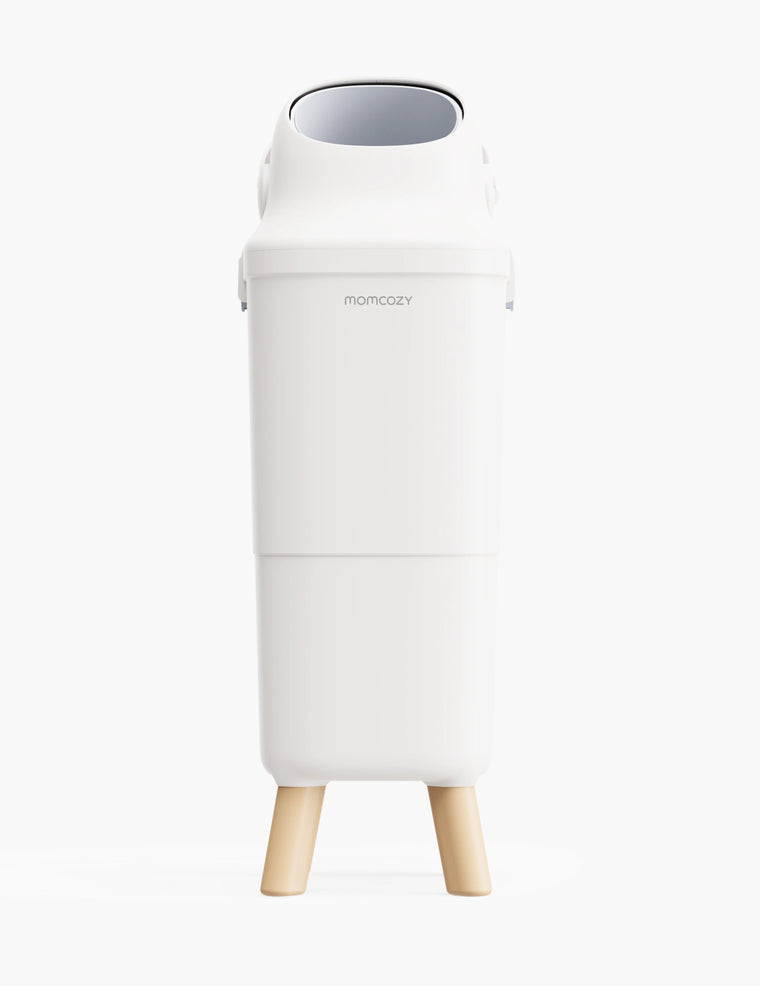
Once you've worked through the framework above, it's easier to see which priorities line up with a specific product. Based on the current UK product listing, the Momcozy Triple-Seal Nappy Bin uses a Triple-Seal odour-control structure with a clamp bag seal, has a wide opening designed for one-handed disposal, offers 22L of capacity, works with standard 13-gallon bin bags rather than a proprietary cassette, and includes a child safety lock.
Best-fit household priorities
This is likely to suit households wanting a dedicated indoor containment system built around a specific sealing mechanism, a wide one-handed opening, and standard bag compatibility rather than a proprietary refill, particularly parents trying to avoid ongoing cassette costs.
When another format may make more sense
If you already empty a small regular bin after every change and that routine works fine, a dedicated system like this may not add much. Equally, if you specifically prefer a cassette-based mechanism and are happy to accept the recurring refill cost, a standard-liner bin may not be the better fit.
Before You Buy: A Final Nappy Bin Checklist
Once you've narrowed things down, verify these points against the current product page or manual rather than category-wide assumptions.
- Odour containment: What seal or closure mechanism is actually described? Don't treat "odour proof" as zero smell in every situation.
- Refill dependency: Does the exact model need proprietary cassettes, or does it use standard liners? Check compatibility for that specific model.
- Running cost: Price the recurring consumables over a realistic period, not just the bin's upfront cost.
- Capacity: Check the litres, external dimensions, and any "holds X nappies" claims; newborn-size counts don't carry over to later stages.
- Emptying: Check how the full bag is removed, tied or cut, and whether that adds extra steps or direct contact with waste.
- One-handed use: Confirm the opening, disposal and resealing motion actually suits your changing routine./
- Footprint and placement: Measure your changing area, including space to open the lid and remove a full bag, not just the bin's base size.
- Child access: If the bin will still be in use once your baby is mobile, check whether a lock exists and how it works.
- Cleaning and maintenance: Check what the manufacturer says can be wiped down or removed, and whether that's realistic for your household.
- Household fit: Reconfirm that a dedicated nappy bin solves a real problem for you; a small bin emptied often can still be the right choice.
Frequently Asked Questions
Do nappy bins need special refill bags?
Some do and some don't. Proprietary cassette systems need brand-specific refills, while other bins work with standard bin bags. Check the specific model if avoiding proprietary refills matters to you.
Should I choose a small or large nappy bin?
It depends on your space and how often you're happy to empty it. Smaller bins suit compact nurseries and frequent emptying, while larger bins reduce bag changes but take up more floor space.
Are cassette-free nappy bins better value?
They can reduce ongoing consumable costs since you're not tied to one brand's refills, but that doesn't automatically mean better odour containment. The two are separate trade-offs.
Can a normal pedal bin be used for nappies?
Yes, particularly if you empty it frequently and have easy access to an outside bin. A dedicated nappy bin becomes more useful when nappies need to sit indoors for longer.
Does a steel nappy bin always control smell better than plastic?
Not necessarily. The sealing mechanism and how consistently the bin is used day to day tend to matter more for odour control than the material it's made from.
What should I prioritise if I live in a flat?
Indoor containment and capacity are usually worth prioritising, since nappies may need to stay inside for longer between trips to a communal or outside bin.
How often should I empty a nappy bin?
This depends on the bin's capacity, your baby's nappy usage, and your own preference. There's no single correct frequency, though most households settle into a rhythm that matches their bin size and household routine.
What changes when my baby becomes a toddler?
Placement and child access become more relevant. It's worth checking whether the bin has a lock or access control and positioning it somewhere a curious toddler can't easily reach or open.
Conclusion
"Best" isn't a fixed answer here. It's the bin whose containment, bag system, capacity and handling actually fit how your household disposes of nappies day to day. Before comparing products, it helps to settle on three must-have criteria for your own home, and to weigh ongoing liners or refills and the emptying method just as heavily as odour claims or the upfront price. From there, you can browse the full nappy bin range with a clearer sense of what actually matters to you.