Living in a flat with a baby can make nappy disposal feel more complicated than it needs to be. The changing area might be in a bedroom, the communal bin store might be downstairs, and getting from one to the other may mean using stairs, a lift or a shared corridor.
If you live in a house with a private wheelie bin outside, taking a used nappy out may be relatively straightforward. In a flat, the final rubbish point may be several floors away or somewhere you only pass when leaving the building. That can make taking every used nappy out immediately impractical.
The most useful approach is to think about nappy disposal setup for flats. First, find out where your property's general waste goes. A dedicated nappy bin can be useful for this, giving you somewhere nearby to dispose of used nappies until it is time to take the household waste out.

Key Takeaways
- Used disposable nappies in UK flats will usually end up in general or non-recyclable waste, unless your council or building has a specific specialist collection.
- Always check your local council and building's waste instructions first.
- A ground-floor flat with an easily accessible bin store may only need a small lidded bin or another simple containment option.
- An upper-floor flat with stairs, lift access or a distant communal bin may benefit from dedicated indoor containment.
- A larger bin is not automatically better for a small flat. Consider footprint and emptying frequency together.
- A dedicated nappy bin does not change which communal waste stream nappies belong in.
- Some parents choose to take poo nappies out sooner, particularly after their baby starts solids.
- Night-time disposal can follow a separate routine if reaching the communal bin would be disruptive.
- If the shared bins are regularly full, the problem is with communal waste capacity, not the size of the bin inside your flat.
First, Find the Final Waste Route for Your Flat
Before deciding where to put a used nappy, find out where it ultimately needs to go.
This is particularly important in a flat because you may have:
- Several communal bins
- A shared bin store
- Different waste areas for different buildings
- A locked refuse area
- Specific bagging instructions
- A specialist local nappy collection
Don't assume that a bin colour or arrangement you have seen somewhere else applies to your building.
Start With These Questions
|
Question |
Why it matters |
|
Where does general household waste go? |
This is usually the final destination for disposable nappies. |
|
Where is the communal bin? |
Distance affects how practical frequent trips are. |
|
Is the bin store inside or outside? |
This changes how easy it is to take waste out during the day or night. |
|
Do you need a key, fob or code? |
Access requirements can make quick trips less convenient. |
|
Are there building-specific waste instructions? |
Communal properties may have their own arrangements. |
|
Does your council offer a specialist nappy collection? |
Some areas have services that others do not. |
For example, some UK councils provide communal general-waste arrangements for flats, while others may have specific instructions for communal properties. Specialist nappy or absorbent hygiene product collections can also exist in particular areas.
So before setting up your indoor routine, check your council's waste A–Z page and any instructions provided by your landlord, managing agent or building.
Remember: An indoor nappy bin is only a temporary containment point. It does not change your property's final waste stream or override council or building rules.
When a Specialist Nappy Service Exists
Some councils have introduced specialist nappy or absorbent hygiene product collections, but these are not available everywhere.
If your council offers one, check:
- Whether your address is eligible
- How nappies should be presented
- Where they should be left
- How frequently they are collected
- Whether the service applies to flats or communal properties
Do not assume that a specialist service available in one part of the UK applies to your flat.
Map the Real Route: Changing Area → Indoor Hold → Communal Bin
Once you know the final waste route, look at the journey between your baby's changing area and the communal bin. This is where flat living can make a difference. A parent in a ground-floor flat with a bin store beside the entrance may have almost no gap between changing and disposal.
Someone living several floors up may need to:
- Leave the changing room.
- Walk through the flat.
- Take the stairs or lift.
- Pass through a communal area.
- Reach the bin store.
- Return to the flat.
If that journey has to happen after every nappy change, it can quickly become impractical.
Build Your Disposal Route
Step 1: Find the main changing area
Where do most changes happen?
- Nursery
- Bedroom
- Living room
- Bathroom
- More than one room
Step 2: Decide whether you need temporary indoor containment
If the communal bin is easy to reach, you may not. If it is several floors away, a contained indoor holding point may make more sense.
Step 3: Identify your normal rubbish trips
You may already leave the flat for:
- Work
- School or nursery
- Shopping
- Walking the dog
- Exercise
- Appointments
- Other household errands
These trips can become natural opportunities to take rubbish to the communal bin.
Step 4: Choose your emptying routine
The aim is not to follow a universal schedule. Instead, choose a routine that works with:
- How frequently your baby needs changing
- How far the bin store is
- How much waste you are comfortable keeping indoors
- The layout of your flat
- Your household's usual trips outside
The Shortest Practical Route Wins
Think about where each part of the process happens:
Change baby → contain used nappy → continue your day → take waste downstairs/outside → place it in the correct communal bin.
For some households, that entire process may take a few minutes. For others, the indoor containment stage removes several unnecessary trips.
The trade-off: Fewer trips to the communal bin usually mean used nappies stay indoors for longer. Your setup needs to balance convenience with how frequently you prefer to empty it.
When a Small Lidded Bin May Be Enough
You do not automatically need a dedicated nappy bin just because you live in a flat. A small lidded bin may be enough when the communal bin is easy to reach and you are happy to empty your indoor waste frequently.
A Simple Setup May Work If:
- You live on the ground floor.
- The bin store is close to the entrance.
- You leave the flat regularly.
- The communal bin is easy to access.
- Your changing area has limited space.
- You prefer frequent emptying.
This keeps the system simple without adding another large item to a small room.
Why Smaller Capacity Can Sometimes Be Useful
A smaller bin means:
- Less floor space used
- Less waste stored indoors
- A lighter bag to carry
- More frequent emptying
That last point can actually be useful. If you already pass the communal bin several times a day, there may be little reason to store a large quantity of used nappies indoors. The trade-off is that you need to empty it more frequently.
If you are unsure whether a dedicated nappy bin is worthwhile for your household, see our guide on do you need a nappy bin.
Good fit: Easy-access flat + frequent rubbish trips + limited floor space.
Less useful: Upper-floor flat + distant bin store + frequent newborn changes.

When Dedicated Indoor Containment Becomes More Useful
A dedicated nappy bin becomes more useful when getting to the communal bin is the difficult part.
This is particularly relevant for:
- Upper-floor flats
- Buildings without lifts
- Flats with distant bin stores
- Buildings with locked communal waste areas
- One-caregiver households
- Periods of frequent newborn changes
The issue is not necessarily how much waste your baby produces. It is the number of inconvenient trips required to get rid of it.
Upper-Floor or No-Lift Flats
Imagine living on the third floor without a lift.
Your baby may need several nappy changes during the day. If every used nappy means a trip downstairs and back, the disposal routine becomes much more demanding than it would be in a house with a private bin outside.
In this situation, temporary indoor containment can reduce unnecessary journeys.
One Caregiver at Home
If you are the only adult at home during the day, you may not want to leave your baby every time a nappy needs to go downstairs.
A nearby containment point gives you another option:
Change → contain → finish what you're doing → take waste out during the next suitable trip.
This does not mean you need to keep waste indoors all day. It simply means you are not forced to make a separate trip after every change.
When the Bin Store Is Far Away
Floor level is not the only consideration. A ground-floor flat can still have difficult bin access if the communal refuse area is:
- Around the side of the building
- Behind a locked door
- Across a car park
- At the other end of a communal corridor
- Outside the building
That is why the actual route matters more than simply asking whether your flat is upstairs or downstairs.
|
Flat setup |
Likely disposal consideration |
|
Ground floor + bin beside entrance |
Small lidded bin may be enough |
|
Ground floor + distant bin store |
Consider how often you naturally pass it |
|
Upper floor + lift |
Indoor containment may still be useful |
|
Upper floor + stairs only |
Dedicated containment may reduce repeated trips |
|
Bin store outside building |
Consider when you naturally leave the flat |
|
One caregiver + distant bin |
Nearby containment may be particularly practical |
These are examples, not rules. Your own routine should make the final decision.
Small Space Does Not Always Mean the Smallest Bin
A small flat can make every centimetre of floor space feel valuable. But choosing the smallest possible nappy bin is not always the most practical solution.
You need to balance two things:
1. Footprint
How much space does the bin actually take up?
2. Emptying Frequency
How often will you need to take the waste to the communal bin? A tiny bin may fit beside the changing area but require frequent emptying. A larger bin may reduce trips but take up more room and hold waste indoors for longer.
Before Choosing a Disposal Point, Check:
- Width: Does it fit beside the changing area?
- Depth: Does it interfere with furniture?
- Height: Can you use it comfortably?
- Lid clearance: Can the opening work without hitting a wall or furniture?
- Walking space: Does it narrow the route through the room?
- Emptying route: Can you remove the bag without moving half the room?
- Storage: Where will replacement bags be kept?
Don't rely solely on descriptions such as "compact" or "small space friendly". Measure the area you actually have.
Check the Emptying Path, Too
A bin can fit perfectly beside the changing table and still be awkward to empty.
Think through the entire route:
Bin → bag removal → flat entrance → lift/stairs → communal bin store
If the bag is difficult to remove or carry, the storage location may not be as convenient as it first appears.
For broader advice on choosing between different nappy-bin features, see how to choose the best nappy bin.
Build a Different Routine for Night Changes if You Need One
Night-time disposal can be slightly different in a flat.
If the communal bin is several floors away, you may not want to make a trip downstairs after a 2 a.m. nappy change.
A simple solution is to have a contained indoor disposal point near the night-time changing area and take the waste out during the next suitable trip.
A Simple Overnight Flow
Night change → contain used nappy → settle baby → take waste out later
This does not need to become a completely separate waste system. You may simply use the same nappy bin during the day and night, or have a smaller temporary point upstairs if that suits your layout.
The important thing is to avoid leaving used nappies exposed in a communal hallway or another unsuitable area. For the wider overnight routine, see our guide to night-time nappy change setup.
Poo Nappies May Change the Timing
Your nappy disposal routine may also change as your baby grows. A system that works well during the early months may feel different once your baby starts solids. Many parents become less comfortable keeping poo nappies indoors for longer at this stage, so they may choose to take them to the communal bin sooner. That does not necessarily mean you need a different bin. It may simply mean changing when you empty it.
Before Solids
You may find that your existing indoor containment routine works well. If the communal bin is difficult to reach, you might wait until your next planned trip outside.
After Solids
You may prefer to take poo nappies out sooner, especially if the smell becomes more noticeable. You can still keep other used nappies until the next normal rubbish trip if that works for your household.
During Warmer Weather
Warm rooms may also make you less comfortable with longer indoor storage. If that happens, consider shortening the time between emptying rather than immediately changing the entire disposal system.
The practical rule: Your emptying routine can change as your baby grows. What worked for a newborn does not have to remain your routine forever.
If you need more detailed advice about persistent nappy-bin odours, see how to stop a nappy bin smelling.
Communal Bin Capacity Is a Building Problem, Not an Indoor-Bin Problem
A dedicated nappy bin can help with the waste inside your flat. It cannot create more space in the communal bin store. If the shared refuse bins are constantly full, buying a larger bin for your flat will only allow you to store more waste indoors before you face the same problem.
If the Communal Bins Are Regularly Full
Consider contacting:
- Your landlord
- Managing agent
- Building manager
- Residents' management company
- Local council
The appropriate contact will depend on your property's waste arrangements.
You may need to raise issues such as:
- Not enough communal bins
- Bins regularly overflowing
- Difficult or restricted access
- Unclear disposal instructions
- Problems with collection frequency
A Bigger Indoor Bin Is Not a Fix for Poor Communal Capacity
Think of the two systems separately:
|
Indoor problem |
Possible household solution |
|
Used nappies need temporary containment |
Small lidded bin or dedicated nappy bin |
|
Bin store is far away |
Plan fewer, more practical trips |
|
Night-time trip is inconvenient |
Temporary overnight containment |
|
Communal bins are full |
Contact the responsible building/council service |
|
Unclear waste rules |
Check council/building guidance |
Your indoor setup can make the journey easier, but it cannot replace an adequate communal waste system.
What a Flat-Friendly Nappy Disposal Point Should Let You Do
Once you have decided that indoor containment would make your routine easier, you can look at the features that matter.
The important thing is to choose around your flat's workflow, not simply around product specifications.
Look for:
A suitable footprint
The bin should fit without blocking a doorway, changing area or normal walking route.
Easy operation
You should be able to dispose of a used nappy without unnecessary steps.
Good containment
If nappies will remain indoors between changes and rubbish trips, the bin should be designed to contain waste appropriately.
Straightforward emptying
Removing the bag should not create another awkward job when you are already navigating stairs or a communal corridor.
Child-access considerations
As your baby becomes mobile, the position and access features of the bin become more important.
Practical bag compatibility
If storage space is limited, consider how easy replacement bags are to find and store.
Where the Momcozy Triple-Seal Nappy Bin Fits
If your flat's layout makes dedicated indoor containment useful, the Momcozy Triple-Seal Nappy Bin is one option to consider.
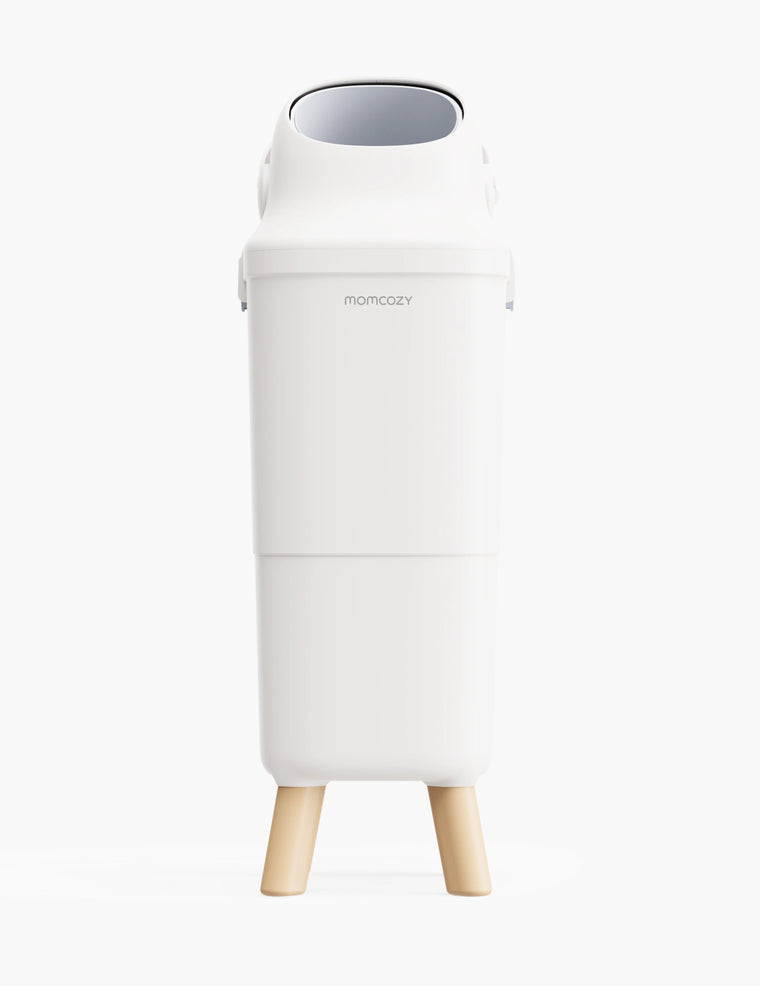
The current UK product page lists:
- 22L capacity
- Wide opening
- Child safety lock
- Transparent window
- Triple-Seal odour-control design
- Patented clamp bag seal
- Standard 13-gallon bin-bag compatibility
- Hands-free disposal
These features are particularly relevant to a flat where nappies may need to stay contained indoors between changes and the next trip to a communal bin. However, the product should come after the workflow decision.
If your flat has a communal bin directly outside the entrance and you prefer to empty a small bin frequently, a dedicated nappy bin may not be necessary. If your bin store is several floors away, the extra containment may be more useful.
Three Flat Setups That Can All Be Reasonable
Different flats can need completely different disposal routines.
Setup 1: Ground-Floor Flat + Nearby Bin Store
Best suited to: Easy-access buildings
Routine: Change → small lidded bin → take out when leaving → communal bin
Why it can work:
- Short disposal route
- Easy access
- Little indoor storage required
- Small footprint
Trade-off: More frequent emptying.
Setup 2: Upper-Floor Flat + Distant Communal Bin
Best suited to: Flats where every rubbish trip involves stairs, a lift or a long walk
Routine: Change → dedicated indoor containment → planned rubbish trip → communal bin
Why it can work:
- Fewer repeated trips
- Easier during frequent newborn changes
- Useful when one caregiver is handling changes
Trade-off: Used nappies remain indoors for longer.
Setup 3: Small Bedroom + Daytime Changes Elsewhere
Best suited to: Families whose baby sleeps upstairs but spends most of the day elsewhere
Routine:
- Daytime: Main changing area → main disposal point
- Night: Bedroom → small contained disposal point → communal bin during the next suitable trip
Why it can work:
- No need for a complete second changing station
- Keeps overnight disposal practical
- Adapts to how the flat is actually used
Trade-off: Two disposal points need to be maintained.
Quick Comparison
|
Flat scenario |
Possible setup |
Main benefit |
Main trade-off |
|
Ground floor + nearby bin |
Small lidded bin |
Easy, low-cost routine |
More frequent trips |
|
Upper floor + distant bin |
Dedicated indoor containment |
Fewer trips downstairs |
Longer indoor holding |
|
Small bedroom |
Small night-time point |
Saves space |
Two points to maintain |
|
One caregiver |
Nearby containment |
Less interruption |
Requires a clear emptying routine |
|
Frequent outdoor trips |
Take waste out naturally |
No large indoor bin needed |
Depends on your schedule |
These are examples rather than universal recommendations. The best setup depends on your actual building.
Frequently Asked Questions
Can disposable nappies go in a communal bin?
Usually, disposable nappies go into the property's general or refuse waste rather than recycling. However, communal arrangements and specialist collection services vary between councils, so check your local guidance and building instructions.
Do I need a nappy bin if I live in a flat?
Not necessarily. A dedicated nappy bin is more useful when the communal bin is inconvenient to reach and you want a contained indoor holding point between changes and rubbish trips.
Should every used nappy go in a separate nappy sack?
There is no universal rule that every household must use a separate nappy sack. Follow your local council and building's instructions, including any bagging requirements.
What should I do if the shared rubbish bin is always full?
Contact the person responsible for your property's waste arrangements, such as your landlord, managing agent, building manager or council. A larger indoor nappy bin cannot solve inadequate communal waste capacity.
Is a small nappy bin always better for a small flat?
No. A smaller bin saves floor space but may need more frequent emptying. A larger bin can reduce trips but takes up more room and may keep waste indoors for longer. Consider footprint and emptying frequency together.
Do poo nappies need a different bin?
Not necessarily. Poo nappies generally follow the same final waste route as other disposable nappies, subject to local rules.
Can I leave dirty nappies by the front door until I go downstairs?
Avoid leaving used nappies exposed or unsecured. If waste needs to remain indoors temporarily, use an appropriate contained method and keep it within your own flat. Do not use communal corridors, stairwells or shared areas as informal rubbish storage.
What if the communal bin is outside the building?
You can build the outdoor trip into your normal routine.
If you do not want to go outside after every change, use a suitable indoor holding point and take the waste out when you next leave the flat.
Do I need a nappy bin upstairs if my main changing station is downstairs?
Not automatically. If upstairs is only used occasionally, you may prefer a portable changing setup and a simple contained disposal point. If you regularly change your baby upstairs, especially overnight, dedicated indoor containment may be more convenient.
Can I use the same disposal setup day and night?
Yes. Some families use one central system, while others prefer a smaller night-time setup because the communal bin is difficult to reach overnight.
Does a bigger nappy bin mean fewer trips to the communal bin?
Potentially, but it is not automatically better. A larger bin can reduce emptying frequency, but it also takes up more space and may mean used nappies remain indoors for longer.
Conclusion
The best nappy disposal in a flat setup starts with the building, not the bin. First, find out where your property's general or refuse waste goes. Check your council and building instructions, including whether any specialist nappy collection applies to your address.
Then look at the real journey between the changing area and the communal bin. You do not need the biggest nappy bin or the most complicated setup. You need a system that fits the way your flat actually works.
If repeated trips to the communal bin are becoming inconvenient, a dedicated option such as the Momcozy Triple-Seal Nappy Bin can provide a contained indoor holding point, with a 22L capacity, wide opening, child safety lock and standard 13-gallon bag compatibility.