Those last weeks of pregnancy can feel like an odd mix of impatience and exhaustion. It's no surprise that so many UK mums start looking into exercises to help induce labour, hoping a bit of movement might nudge things along. Gentle, targeted movement will not force your body into labour, but it may help you feel more prepared, more comfortable, and more in tune with what your body is doing as your due date nears.
Can Exercise Really Help Induce Labour?
No exercise can guarantee labour will start. What gentle movement can do is help your pelvis open, support better positioning for baby, and ease some of the aches that build up in late pregnancy. Labour itself is triggered by a mix of hormonal and physical signals, not by any single stretch or squat.
That said, midwives often encourage mums who are full term to stay lightly active, since upright movement and pelvic mobility work may help things along once your body is already getting ready. Think of these exercises to help induce labour as encouragement rather than a switch you can flip.

Member price
£113.99Code Save 15%
When Is It Safe to Try Exercises to Induce Labour?
It's generally safe to try gentle labour-encouraging movement once you've reached full term and your midwife or doctor has confirmed there's no reason to hold off. Full term in the UK is typically counted from 37 weeks, though most of these exercises are best saved for the final fortnight or two, when your body is naturally closer to labour.
Always check with your midwife first if you've had any pregnancy complications, an unusual bump position, or reduced movement from baby. What's fine for one pregnancy may not suit another.
Can You Try to Induce Labour Before 39 Weeks?
It's best to hold off on labour-encouraging exercises before 39 weeks unless your midwife has advised otherwise. Babies born before this point are more likely to need extra support with breathing and feeding, even if they seem otherwise ready. Gentle pregnancy-safe movement, such as walking or light stretching, is still fine earlier on. It's the more targeted, pelvis-opening exercises that are worth saving for closer to your due date.
Benefits of Exercise in Late Pregnancy
Late-pregnancy movement offers more than just labour prep. It can ease physical discomfort, support your mental state, and help you feel steadier on your feet as your centre of gravity shifts.
Encouraging Baby into the Optimal Position
Upright, gently rhythmic movement can encourage baby to settle head-down with their back facing your front, which is generally considered the easiest position for labour. Rocking or circling the hips while seated allows gravity and motion to work together, rather than leaving baby to find position purely by chance.
Opening and Balancing the Pelvis
Movements that mobilise the pelvis from several directions, forward, back, and side to side, help loosen the muscles and ligaments around the pelvic bones. A more balanced, flexible pelvis gives baby a little extra room to manoeuvre as they descend.
Helping Baby Descend
Staying upright and active, rather than lying down for long stretches, uses gravity to your advantage. Combined with gentle hip movement, this can help baby move deeper into the pelvis in the days before labour begins.
Improving Posture and Body Alignment
As your bump grows, it's common for posture to shift, with the lower back arching and shoulders rounding forward to compensate. Regular gentle exercise helps counter this, keeping your spine better aligned and easing some of the strain on your lower back and hips.
Easing Pelvic Floor Tension
Many of these movements work with your breath to gently engage and release the pelvic floor. That awareness can be genuinely useful heading into labour, when knowing how to soften and release this area supports the pushing stage.
Supporting a Calmer Mind
Slow, breath-led movement has a settling effect that goes beyond the physical. Taking ten quiet minutes to move with intention can ease some of the anxiety that naturally builds as your due date approaches.
The Best Exercises to Help Induce Labour
A stability ball makes several of these movements easier to hold and control, which is one reason maternity balls have become such a familiar sight in late-pregnancy fitness routines. Below are a handful of movements worth trying at home.
Dynamic Squat
Stand facing the ball with feet slightly wider than shoulder-width apart, hands resting on your hips. Send your hips back until they lightly tap the ball, then press through your feet to rise back up. Keep the knees soft as you stand rather than locking them out, since that's the detail most people rush past.

Pelvic Rocking
Sit centred on the ball with your hands on your knees. On an exhale, lift the right side of your pelvis while your right foot stays grounded and your left leg lengthens naturally, then switch to the left side on the next breath. The sway should feel small and controlled, closer to a gentle pendulum than a bounce.

Charlie Chaplin Walk
Stand with your feet turned slightly outward. Lift one leg, rotate the toes further out, and place the foot back down before switching sides, as though you're taking a slow, easy stroll. It looks a bit playful, and that's the point, since it eases tension through the glutes, outer hips, and calves without any real effort.

Mermaid Position
Sit with your legs folded into a relaxed side position, one hand resting lightly on the ball beside you. On an exhale, reach up and over toward the ball, letting your opposite side lengthen. Sitting on a folded towel or cushion can take pressure off your hips if the floor feels hard.

Single-Leg Stability Series, Pelvic Lift
Sit steadily on the centre of the ball with your feet comfortably apart. As you exhale, lift your hips just slightly off the ball so you feel the pelvic floor engage, then lower back down on your inhale. Keep the lift small. This one is less about the range of motion and more about the connection you build with your pelvic floor.

Move slowly through each of these, and stop the moment anything feels sharp, painful, or dizzying rather than simply effortful.
How to Use an Exercise Ball to Induce Labour
Start by choosing a ball that lets your knees sit at roughly a right angle when you're seated with feet flat on the floor. Set it on a non-slip surface or a yoga mat, never a smooth or uneven floor, and keep a wall or sturdy chair within reach in case you need extra balance.
Sit tall with your shoulders relaxed rather than hunched, and move with control instead of momentum. Five to ten minutes at a time is plenty to start with, and you can build from there if it feels comfortable.
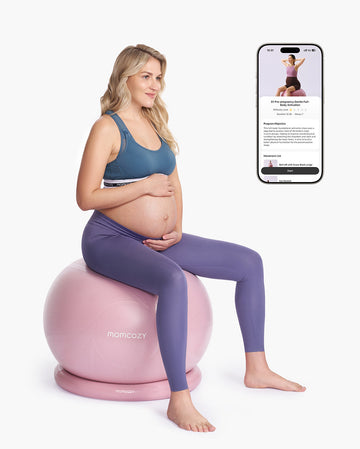
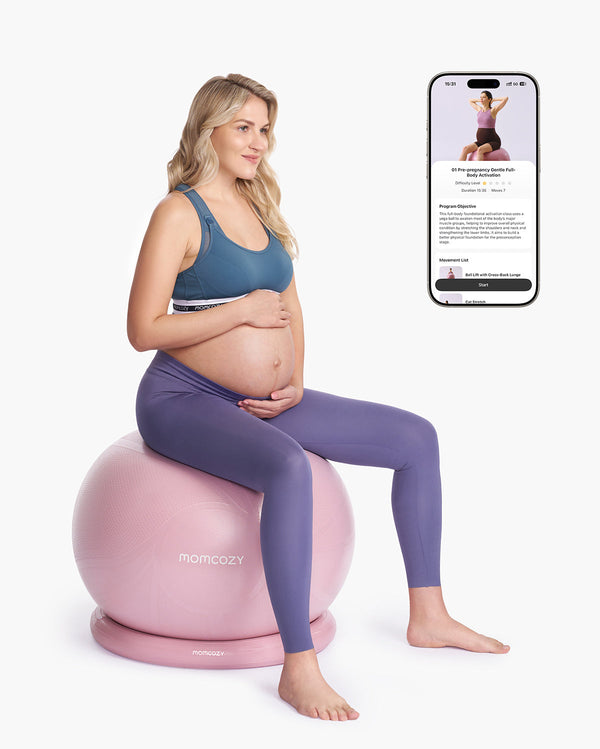
A dedicated set like the BirthEase Pregnancy Ball Set is worth considering if you'd rather not guess at sizing and setup. It pairs an anti-burst ball with a stability base so it stays put on hard flooring, plus stage-based video courses that walk you through pregnancy, labour prep, and postpartum movement without needing to work out the right form on your own.
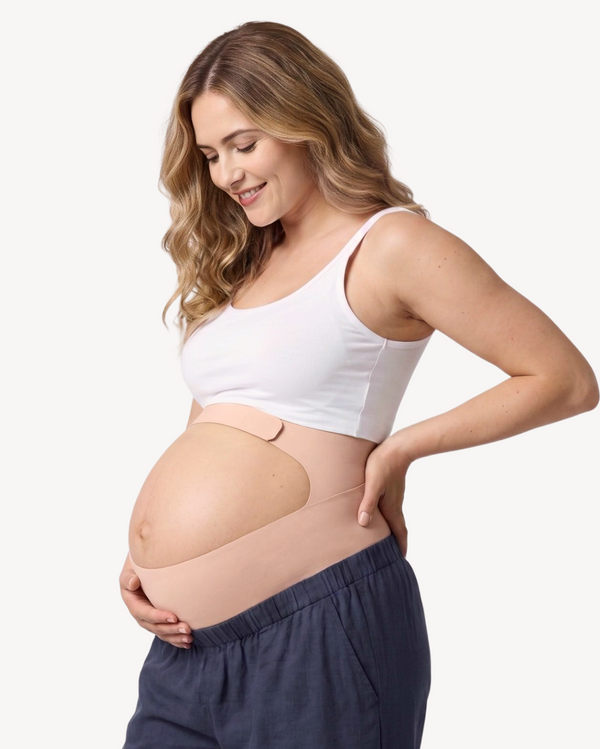
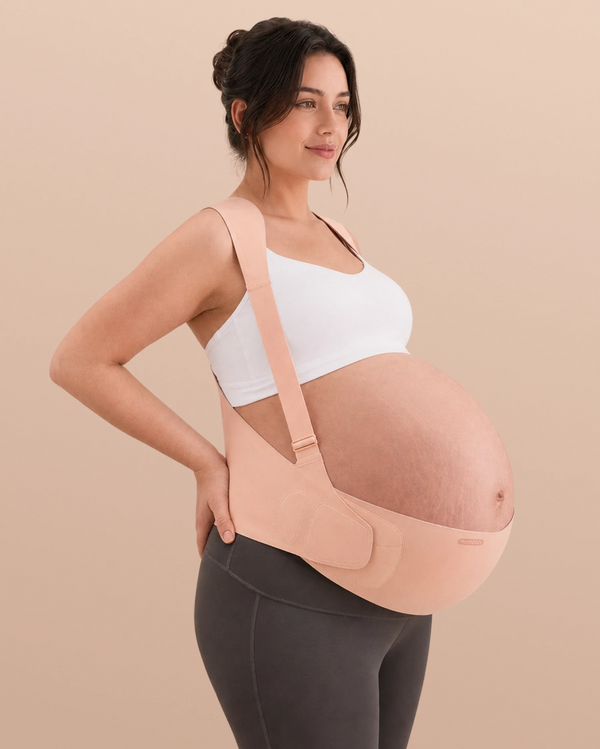
If your lower back tends to ache during these sessions, a supportive belly band can take some of the load off. The BumpEase Momcozy Ergonest Maternity Belly Band is built for most expecting mums who want lightweight, everyday support without anything bulky underneath their clothes.
For mums carrying a twin pregnancy bump, triplets, or a larger and heavier bump generally, the Momcozy Go As You Grow™ Maternity Belly Band is designed with sturdier support built in, since a bigger bump tends to need more than a lightweight band can offer.
Evidence on maternity support belts is still mixed, but a peer-reviewed pilot trial published in BMC Pregnancy and Childbirth found that pregnant women using a pelvic support belt saw pain scores drop and functional ability improve by roughly a third within three weeks, with the wider, more flexible style proving most comfortable to wear (Flack et al., 2015). Mayo Clinic echoes this, noting that while research on support belts remains mixed, many pregnant people find the extra support genuinely helpful, and recommends having it checked by a healthcare professional for correct fit and positioning. For mums carrying twins, triplets, or an especially heavy bump, a sturdier band with reinforced structure, like Go As You Grow™, sits in a different support category altogether than a lightweight band built for a single, average-sized bump.
You can browse the full range of Momcozy pregnancy belly bands to find the fit that suits your bump.
Does Bouncing on a Ball Help Dilate the Cervix?
Bouncing may help encourage baby's head to apply gentle, even pressure against the cervix, but it doesn't directly cause dilation on its own. It's best understood as one part of a broader pattern of upright, pelvis-friendly movement rather than a standalone trick.
How Ball Exercises May Help Baby Descend
Sitting upright on the ball keeps your pelvis open in a way that lying down simply can't match. As you bounce lightly, the movement can help baby settle lower and engage more fully with the pelvic brim, which is often one of the early physical signs that labour isn't far off.
How Long Should You Bounce on a Birthing Ball?
Short, frequent sessions tend to work better than one long stretch. Brace your knees gently, push off the floor as you inhale, and lower back down with control as you exhale, for around 15 to 20 seconds at a time, resting in between. Stick to light, small movements rather than trying to bounce high.
Can a Birthing Ball Bring on Contractions?
A birthing ball is not a reliable way to bring on contractions by itself. It may help your body feel more prepared once labour is already close, but it won't override the hormonal and cervical signals that actually start the process. Only try bouncing once you're full term, generally from 37 weeks, and your midwife has confirmed it's appropriate for your pregnancy.
How Long Should You Exercise to Encourage Labour?
Fifteen to thirty minutes a day, broken into shorter sessions if that feels more manageable, is a reasonable target for most full-term mums. There's no evidence that pushing for longer sessions speeds anything up, and overdoing it is more likely to leave you drained than to bring on labour any sooner.
Pay attention to how you feel afterwards. A bit of pleasant tiredness is normal; sharp pain, dizziness, or breathlessness is a sign to stop and rest.
Other Ways to Naturally Encourage Labour
Beyond ball work, a few simple habits may support your body as it gets ready.
- Staying upright during the day rather than sitting or lying down for long stretches, since gravity does some of the work for you.
- Warm baths or showers to ease tension and encourage relaxation, which can sometimes help the body let go a little.
- Eating dates in the final weeks, which some small studies have linked to shorter labours, though the evidence is limited.
- Nipple stimulation, which some midwives suggest can encourage natural oxytocin release, but only with your midwife's guidance.
- Rest and good sleep, since a well-rested body tends to cope better once labour does begin.
None of these guarantee anything, but combined with gentle exercise, they may help your body feel more ready.
Natural Induction Methods to Avoid or Use with Caution
Some commonly suggested methods carry more risk than benefit and are worth approaching carefully, or avoiding altogether without medical guidance.
|
Method |
Why caution is needed |
|
Castor oil |
Can cause strong nausea, diarrhoea, and dehydration without reliably starting labour |
|
Herbal supplements (e.g. raspberry leaf in high doses) |
Effects are poorly studied and can interact unpredictably with your body |
|
Intense or high-impact exercise |
May cause exhaustion or injury rather than encouraging labour |
|
Deliberately breaking your waters |
Should only ever be done by a healthcare professional in a clinical setting |
|
Acupressure without professional guidance |
Certain pressure points are best left to a qualified practitioner during pregnancy |
If you're tempted to try any of these, speak with your midwife first. Some carry genuine risks that outweigh any possible benefit.
Who Should Not Use Exercise to Induce Labour?
Exercises to help induce labour aren't appropriate for every pregnancy. Speak with your midwife before trying any of these movements if you have placenta praevia, unexplained vaginal bleeding, a risk of preterm labour, high blood pressure, or a diagnosed high-risk pregnancy.
The same goes if you've noticed reduced movement from baby, have concerns about baby's position, or have any condition your care team has flagged for extra monitoring. When in doubt, it's always worth a quick call to your midwife rather than guessing.
When Should You Stop Exercising?
Stop straight away if you notice vaginal bleeding, fluid leakage, sudden dizziness, chest pain, a severe headache, swelling in one calf, or reduced movement from baby. Painful contractions that don't ease with rest are also a clear sign to stop and get checked.
Trust your instincts here. If something feels off, it's always worth calling your midwife rather than waiting to see if it passes.
Frequently Asked Questions
What Is the Fastest Way to Go into Labour?
There isn't a genuinely fast or reliable way to trigger labour naturally. Staying upright, moving gently, and letting your body do its own timing tends to work better than chasing a quick fix, and any medical option for speeding things up should come from your midwife or doctor.
Does Exercise Dilate the Cervix?
Exercise doesn't directly dilate the cervix. It can support pelvic mobility and encourage baby into a good position, which may help once your body is already moving toward labour, but the dilation process itself is driven by hormonal and physical changes exercise can't control.
Can Walking Induce Labour?
Walking won't force labour to start, but it's one of the simplest ways to stay upright and keep your pelvis moving. Many mums find a daily walk in the final weeks genuinely comfortable, and it carries very little risk when done at an easy pace.
Do Squats Help Induce Labour?
Gentle, supported squats may help open the hips and encourage baby to settle lower, though they won't guarantee labour begins. Keep the movement shallow and controlled, and hold onto something stable, such as a chair or a ball, rather than squatting unsupported.
How Long Should I Exercise to Induce Labour?
Fifteen to thirty minutes a day is a sensible amount for most full-term mums, split into shorter sessions if that suits you better. Longer sessions haven't been shown to work any faster, so there's little benefit in pushing past what feels comfortable.
Move Gently and Trust Your Body
Exercises to help induce labour won't override your body's own timeline, but gentle ball work, walking, and pelvis-friendly movement can ease discomfort and help you feel steadier as your due date nears. Pair movement with proper support, from a stability ball to a well-fitted belly band, and check in with your midwife before trying anything new. Above all, listen to what your body is telling you each day.